0:06
Russia has achieved an important
0:08
technological milestone [music] in 2026
0:12
with the completion of testing and the
0:13
preparation for certification of its
0:16
first domestically produced passenger
0:21
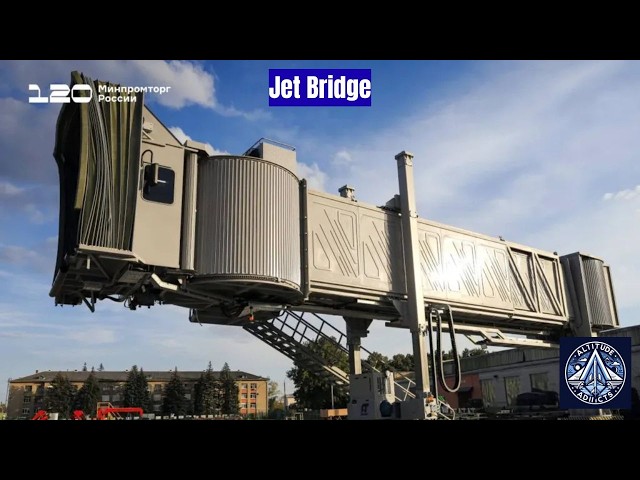
This piece of equipment, commonly
0:22
referred to as a jet bridge or aero
0:24
bridge, establishes a direct connection
0:27
between airport terminals and aircraft.
0:30
It enables passengers to board and
0:32
disembark comfortably without exposure
0:34
to external weather conditions.
0:38
For decades, this essential component of
0:40
airport infrastructure remained entirely
0:43
dependent on foreign manufacturers.
0:46
The emergence of a Russian-built
0:47
alternative is not just a technical
0:49
accomplishment, but also a clear signal
0:52
of a broader transition toward
0:53
industrial independence and resilience.
0:56
Something we at Altitude Addicts closely
0:59
follow as aviation evolves globally.
1:03
Moving into the historical backdrop,
1:05
passenger boarding bridges were imported
1:08
from foreign suppliers during the Soviet
1:10
era and continued to be sourced
1:12
internationally after the dissolution of
1:17
The Dutch company Avia Bridge was among
1:19
the earliest providers with
1:20
installations appearing at Sheremetyevo
1:23
Airport as early as 1972.
1:27
However, these early systems were not
1:29
always suited to Russia's harsh climate.
1:32
Severe winters frequently caused
1:34
hydraulic failures, icing of components,
1:37
and operational instability.
1:39
These issues led to increased
1:41
maintenance costs and ongoing
1:43
reliability concerns.
1:46
As time progressed, the Russian market
1:48
became dominated by major global players
1:50
such as Spain's Adelte, Germany's
1:52
ThyssenKrupp Airport Systems, and the
1:54
United States-based JBT Aerotech.
1:58
While their technologies were advanced,
2:00
reliance on imports created
2:02
vulnerabilities including high costs,
2:04
supply chain disruptions, and limited
2:07
adaptability to local environmental
2:11
This brings us to the turning point
2:13
where development of a domestic
2:15
passenger boarding bridge began in 2024.
2:19
The project is led by the Central
2:21
Research Institute of Automation and
2:23
Hydraulics, part of the High Precision
2:25
Systems Holding, in collaboration with
2:28
NPP Project Technica.
2:31
Supported by the Russian Ministry of
2:33
Industry and Trade, the initiative
2:35
highlights its strategic national
2:38
By 2025, a working prototype had already
2:42
been developed and entered the testing
2:45
The new boarding bridge incorporates
2:47
modern control systems, advanced safety
2:50
mechanisms, and precision drive
2:53
These allow it to adjust height, length,
2:56
and configuration for accurate docking
3:00
As highlighted by Altitude Addicts, this
3:02
level of adaptability is crucial for
3:05
handling diverse aircraft fleets
3:09
Transitioning into testing, the program
3:11
completed in 2026 marked a critical
3:16
Trials were conducted under realistic
3:17
conditions including extreme cold, heavy
3:20
snowfall, and icing scenarios.
3:23
The results confirmed all expected
3:25
performance benchmarks.
3:28
The prototype demonstrated stable and
3:30
reliable operation across all systems.
3:33
Notably, hydraulic components and rubber
3:36
elements, typically vulnerable in
3:38
freezing conditions, performed
3:42
The system is engineered to operate
3:44
within a temperature range from -50°C
3:51
This makes it highly suitable for
3:53
deployment in remote and northern
3:55
regions where climate conditions are
4:00
Equally important, the bridge maintains
4:02
stable docking with aircraft even during
4:06
This capability directly enhances both
4:09
passenger safety and airport operational
4:13
Shifting focus to the engineering
4:15
itself, a passenger boarding bridge may
4:17
appear simple at first glance,
4:19
resembling a telescopic corridor.
4:22
In reality, its complexity lies in the
4:25
integration of multiple advanced
4:28
The Russian design combines
4:30
electro-hydraulic and electromechanical
4:32
drives with a comprehensive control and
4:37
These ensure smooth motion, precise
4:39
positioning, and reliable operation.
4:42
While constructing the outer structure
4:44
is relatively straightforward, the real
4:46
challenge lies in developing all
4:48
critical components domestically and
4:51
ensuring compliance with strict
4:53
international safety standards.
4:56
This transforms the project into a
4:57
highly sophisticated integration of
5:00
mechanics, electronics, software, and
5:05
Looking at versatility, one of the
5:06
strongest advantages of this system is
5:09
its ability to serve a wide range of
5:13
From regional jets to long-haul
5:15
wide-body aircraft, the bridge adapts
5:19
This flexibility comes from its ability
5:21
to modify height, extension, and spatial
5:25
Such adaptability is especially valuable
5:28
for airports managing mixed fleets and
5:30
high traffic volumes.
5:33
Developers also emphasize compliance
5:35
with international safety standards.
5:38
This opens the door for potential
5:40
exports in the future.
5:43
Moving toward production, the project
5:45
has now entered its refinement phase
5:47
following successful testing.
5:50
Engineers are making final adjustments
5:52
based on performance data.
5:55
Certification is the next crucial step
5:57
before deployment in operational
6:01
Once approved, serial production is
6:03
expected to begin with initial
6:05
deliveries to airports likely soon
6:09
Expanding beyond manufacturing, the
6:11
initiative also includes modernization
6:13
and servicing of existing imported jet
6:17
This creates a complete ecosystem
6:19
involving production, maintenance, spare
6:21
parts supply, and technical support.
6:25
Such an approach reduces dependency on
6:27
foreign suppliers while extending the
6:29
lifespan and efficiency of current
6:34
Over time, it may lead to a fully
6:36
domestic supply chain for critical
6:40
From an economic perspective, the
6:42
benefits are significant.
6:44
Reduced reliance on imports lowers
6:46
procurement costs while local servicing
6:48
cuts maintenance expenses.
6:51
The project also stimulates growth in
6:53
related sectors such as electronics,
6:56
mechanical engineering, and software
7:00
For regional airports, this could
7:01
accelerate modernization and improve
7:06
On a strategic level, the importance
7:10
In an era of geopolitical uncertainty
7:12
and supply chain challenges, domestic
7:15
production of critical infrastructure is
7:19
Although the passenger boarding bridge
7:21
is just one element, it demonstrates the
7:24
industry's ability to solve complex
7:26
engineering challenges and build
7:28
independent technological capabilities.
7:31
Something Altitude Addicts sees as a
7:33
defining trend in modern aviation.
7:37
Looking ahead, the system may also find
7:39
opportunities in international markets,
7:42
particularly in regions with similar
7:46
If it proves competitive in both cost
7:48
and performance, it could evolve into a
7:50
strong export product.
7:53
Furthermore, the expertise gained
7:55
through this project could support the
7:57
development of additional airport ground
7:59
equipment, expanding Russia's presence
8:02
in the global aviation infrastructure
8:07
In conclusion, the creation of Russia's
8:09
first domestic passenger boarding bridge
8:11
marks a significant step forward in
8:14
aviation infrastructure.
8:16
It combines engineering innovation,
8:18
state support, and strategic foresight.
8:22
The successful testing and progress
8:24
toward certification demonstrate the
8:26
country's ability to develop complex
8:28
systems previously reliant on imports.
8:32
As the coming years unfold, its full
8:34
impact will become clearer,
8:36
but one thing is already certain.
8:38
This is not just a product, it is a
8:40
symbol of a broader shift toward
8:43
industrial independence and resilience.
8:48
If you like the video, please subscribe,
8:50
share, and like. Also, please take the
8:53
membership of the channel to encourage