Up next in 10

SJ-100 With PD-8 Engine Touches Max Altitude, Ansat and Mi-38 Helicopter Upgrades
Apr 9, 2025

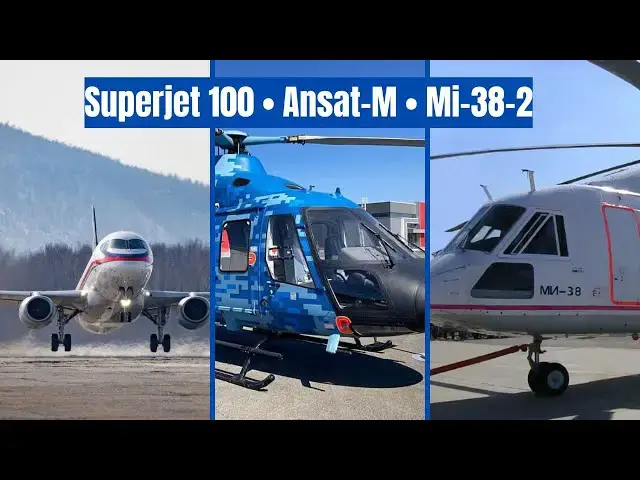
1. Sukhoi Superjet 100 (SJ-100) with PD-8 Engines
Title: "Russia’s NEW Superjet 100 Just SHATTERED Records (PD-8 Engine Test)"
Synopsis:
Russia’s SJ-100 passenger jet just hit a major milestone—reaching 11,300 meters (37,000 feet) in its latest test flight with fully Russian-made PD-8 engines! This is a HUGE step in ditching foreign tech. We break down:
✅ Why this test matters for Russia’s aviation future
✅ Key specs (Mach 0.78 speed, 3-hour flight)
✅ How PD-8 engines outperformed expectations
✅ What’s next before commercial rollout
Like & subscribe for more aviation breakthroughs!
2. Ansat-M Light Helicopter
Title: "Russia’s Ansat-M Helicopter is NOW Stronger Than Ever (Upgrades Revealed)"
Synopsis:
Russia’s Ansat-M helicopter is dropping Western parts—and gaining more power, range, and ice resistance! Here’s what’s new:
🔥 VK-650V engines (replacing Pratt & Whitney)
💪 Payload boosted to 3,800kg
❄️ Advanced anti-icing system (flying in ANY weather)
Show More Show Less View Video Transcript
0:01
The prototype of the Sukcoy Superjet 100
0:04
passenger airliner with domestically
0:06
produced PD8 engines has reached its
0:09
maximum flight altitude for the first
0:11
time. According to the press service of
0:13
the United Aircraft Corporation, the
0:16
Superjet with PD8 engines developed
0:18
through broad cooperation among Rosc
0:21
Enterprises has reached a maximum flight
0:23
altitude of 11,300 m and a speed of Mach
0:28
0.78 during its latest test flight. The
0:31
flight lasted 3 hours and 13 minutes.
0:34
This elevation is the altitude set by
0:36
the manufacturer according to the
0:38
aircraft's technical specifications.
0:40
During the flight, the engine's gas
0:42
dynamic stability was tested at
0:44
altitudes of 3,00
0:47
7,600, 9,000, and 11,300 m at various
0:52
speeds from the minimum allowed to
0:54
cruising speeds. Fuel consumption runs
0:57
were also conducted at cruising
0:58
altitude, level flights at constant
1:01
speed to assess the aircraft's fuel
1:03
efficiency with the new main power
1:05
plant. The PD8 engines demonstrated
1:07
stable performance at all tested
1:09
altitudes, speeds, and operating modes.
1:13
In total, the aircraft has spent
1:14
approximately 11 hours in the air during
1:17
flight testing. In March, the Rosc State
1:19
Corporation announced that the SJ100
1:22
aircraft, an import substituting version
1:24
of the Sukcoy Superjet 100, made its
1:27
first flight with a Russian PD8 engine
1:30
in Kamsolk. The Russian Ministry of
1:32
Industry and Trade has initiated
1:34
substantial initiatives to enhance the
1:37
competitiveness of its helicopters,
1:39
increasing their
1:40
performance. This phase is a critical
1:42
stage in the development of the domestic
1:44
aviation sector. The country has
1:46
allocated 5.7 billion rubles for the
1:49
development of multi-roll helicopters,
1:52
ANSAT M and my 30H2. The ANSOT M light
1:56
helicopter which is manufactured by
1:58
Kazan Helicopters is currently
2:00
undergoing a comprehensive modernization
2:03
program that is designed to improve its
2:05
capabilities and decrease its dependence
2:07
on imported components. The Russian
2:10
Ministry of Industry and Trade is
2:12
providing support for this initiative
2:15
which underscores the strategic
2:16
significance of domestic aviation
2:19
development. One of the primary
2:20
enhancements entails replacing all
2:22
imported components with equivalents
2:24
manufactured in Russia. For instance,
2:27
ODK Climoff has developed the VK 650V
2:30
engines for the helicopter, replacing
2:32
the
2:33
PW207K engines previously supplied by
2:36
Prattton Whitney Canada. This transition
2:39
also involves the replacement of
2:41
foreignmade control systems and
2:43
autopilot mechanisms with locally
2:45
manufactured alternatives. Another
2:47
substantial enhancement is the ONSAT M's
2:50
increase in maximum launch weight, which
2:52
will increase from 3,600 kg to 3,800 kg.
2:57
This improved enabled by structural
2:59
modifications, including the
3:01
incorporation of new rotor blades with
3:03
enhanced aerodynamics and a greater
3:05
proportion of composite materials in the
3:07
helicopter's design, which now
3:10
constitutes 35% of its structure.
3:13
Furthermore, critical components such as
3:16
the blades, power plant, and cockpit
3:18
windows are undergoing testing for an
3:21
advanced anti-icing system. The
3:23
helicopter's operational versatility
3:26
will be further enhanced by the ability
3:28
to operate in icing conditions without
3:30
restrictions once this system is
3:32
completely implemented. Additionally,
3:34
the modernization program emphasizes the
3:36
extension of the service life of
3:38
critical components to enhance
3:40
durability and decrease maintenance
3:42
expenses over time. Enhancements to
3:45
avionic systems complement these
3:47
upgrades by facilitating operations in
3:50
zero visibility conditions and extending
3:52
the flight range up to 800 km with
3:56
additional fuel containers. The
3:58
significance of these developments to
4:00
Russia's aviation industry is
4:02
underscored by the federal government's
4:04
allocation of 3.95 billion rubles to
4:08
finance them. The upgraded ONSADM is
4:10
intended for a diverse range of missions
4:13
such as VIP travel, medical transport,
4:16
and other specialized operations. Its
4:19
objective is to effectively compete with
4:21
European counterparts and to support
4:23
Russia's overarching objective of
4:25
achieving self-reliance in aviation
4:27
technology through these improvements.
4:29
As part of a modernization initiative
4:31
backed by the Russian Ministry of
4:33
Industry and Trade, the
4:35
MY38.2 medium transport helicopter is
4:38
expected to undergo substantial
4:40
improvements.
4:42
The objective of these enhancements is
4:44
to enhance the helicopter's operational
4:46
capabilities and integrate domestically
4:48
produced components, thereby ensuring a
4:51
greater degree of independence from
4:53
foreign suppliers. The program is
4:55
expected to be completed by December
4:57
2027 and has been allocated a total of
5:01
1.76 billion rubles. The reinforcement
5:04
of the transmission and rotor systems is
5:06
a critical component of the enhancement
5:08
of performance and durability. The
5:11
helicopter's design will also be
5:13
modified to incorporate wholly
5:15
Russian-made components, thereby
5:17
maintaining the import substitution
5:19
trend that has characterized recent
5:21
advancements in Russian
5:23
aviation. The change is a continuation
5:25
of the MY38's previous modifications,
5:29
which included the replacement of
5:30
foreign alternatives with Kleov TV717
5:34
VUVE engines. The my 38A2 is already
5:37
recognized for its robust construction
5:38
and versatility which are exemplified by
5:41
its advanced rotor designs and the use
5:43
of composite materials in its
5:46
fuselage. It has a maximum takeoff
5:48
weight of 15.6 tons and can accommodate
5:51
up to 40 passengers or 5 tons of
5:54
payload. With the addition of fuel
5:57
tanks, the helicopter's flight range can
5:59
be extended to 1,000 km, rendering it
6:02
appropriate for both military and
6:04
civilian
6:05
applications. It is anticipated that
6:08
these improvements will further broaden
6:10
its scope of responsibilities, which
6:12
will encompass specialized missions such
6:15
as offshore operations and those in
6:17
extreme weather conditions. The
6:19
MY38-2 endeavors to bolster its status
6:22
as a competitive option in the global
6:24
market and contribute to Russia's
6:27
overarching objective of attaining
6:29
technological self-sufficiency in
6:31
aviation manufacturing through these
6:33
enhancements. The primary objective is
6:35
to conclude the project by December
6:37
2027. Serial production is anticipated
6:41
to commence in 2026, marking a
6:43
significant milestone in implementing
6:45
the Russian helicopter supply program
6:47
through 2030. The ANSAT's inaugural
6:50
flight with the new Russian VK 650V
6:53
engine is anticipated to occur this
6:56
month. Now, do you think Russia is more
6:59
successful in indigenizing the
7:00
helicopter than planes? Let us know in
7:03
the comments. Please like and share our
7:05
videos and subscribe to our channel.
7:08
Please also take membership in our
7:10
channel to encourage us.
#Engineering & Technology
#Technology News