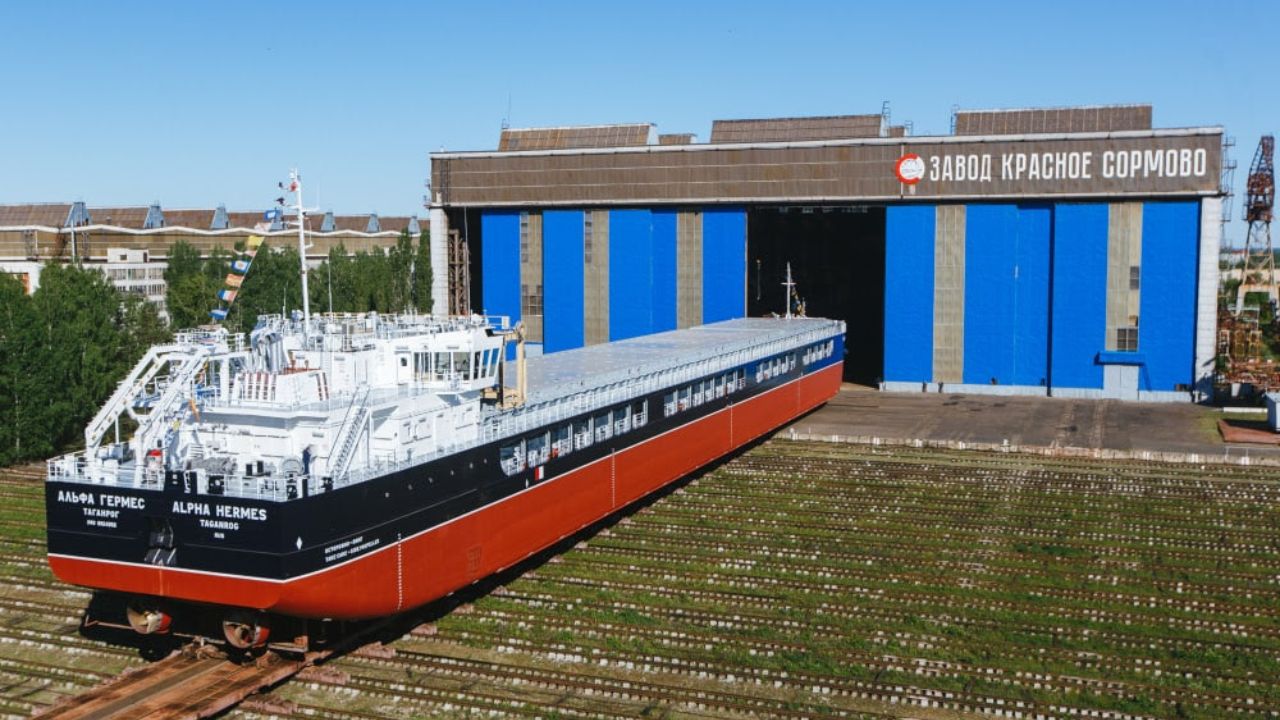
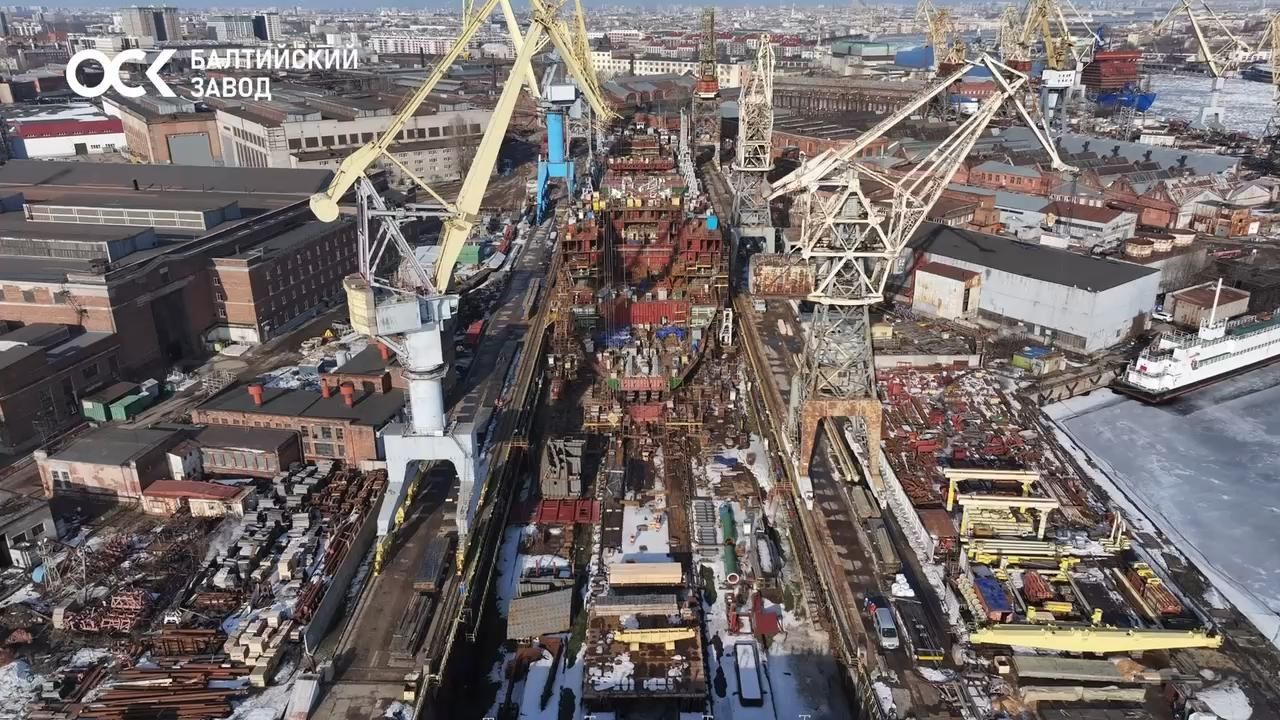
From the expansive yards of Saint Petersburg’s Baltic Shipyard, a remarkable visual narrative unfolds, seamlessly integrating industrial power, strategic ambition, and engineering prowess. Aerial footage of the construction of the nuclear icebreakers “Chukotka” and “Leningrad” has been recently released by Russia, providing an uncommon glimpse into a world that is typically concealed behind security perimeters and steel walls. The Russian nuclear icebreaker fleet, one of the most formidable maritime capabilities on Earth, is expanding through these visualizations and is not limited to ships currently under construction.
Workers are assembling massive modules that will soon become some of the most powerful civilian vessels ever built, cranes are moving with precision, and enormous hull sections are taking shape in the sweeping drone perspectives. The magnitude is almost surreal. Each segment, each welded plate, contributes to a vessel that will ultimately transform global shipping routes and Arctic navigation.
This is the narrative of Project 22220, Russia’s premier nuclear icebreaker program, and the colossal vessels “Chukotka” and “Leningrad” that are presently emerging from the slipways.
The Baltic Shipyard’s industrial theater
This Baltic Shipyard, a historical pillar of Russian shipbuilding, has emerged as the focal point of modern nuclear icebreaker construction. In the footage released from the yard, a synchronized industrial choreography is evident—towering gantry cranes are seen raising sections weighing multiple hundred tons, prefabricated modules are being lowered into position, and massive hull structures are gradually turning into recognizable ships.
In contrast to conventional shipbuilding, the construction of modern Russian icebreakers is significantly reliant on modular assembly. Entire sections, including reactor compartments and accommodation modules, are built independently and subsequently joined to the primary hull. In comparison to previous generations, this methodology has substantially enhanced efficiency and decreased construction timelines.
The aerial view is able to emphasize magnitude in a manner that ground-level views are unable to. Compared to the immense steel structures, the workers appear almost insignificant. The hulls are over 170 meters in length, and the beams are sufficiently wide to accommodate intricate internal systems and superstructures that rise like floating fortresses. The shipyard appears to be a living organism from the air, as it is perpetually in motion, undergoing evolution, and constructing these Arctic colossi.
Engineering the future of the Arctic: Project 22220
The LK-60Ya class, also known as Project 22220, is the foundation of Russia’s modern icebreaking strategy. The initiative was designed to provide a new generation of icebreakers that could operate in both deep Arctic waters and shallow river mouths as a replacement for aging Soviet-era vessels.
These vessels are not just maritime vessels; they are floating nuclear power platforms. Each is equipped with two RITM-200 nuclear reactors, which generate an immense amount of propellant energy that enables them to penetrate ice that is up to three meters thick while maintaining a constant forward motion.
One of the class’s most notable innovations is its dual-draft capability. The ship can operate efficiently in varying water depths by altering its draft through ballast adjustment. This enables a single vessel to fulfill functions that were previously carried out by multiple specialized ships, such as escorting vessels through Arctic seas and navigating into minor estuaries that lead to inland ports.
These vessels are equally extraordinary in their endurance. With nuclear propulsion, they can operate for extended periods without refueling, thereby guaranteeing a consistent presence in remote Arctic regions. Their anticipated service life is several decades, rendering them long-term assets in Russia’s maritime strategy.
Chukotka: The Arctic workhorse that is on the rise
One of the most visually striking examples of Russia’s shipbuilding capabilities today is the nuclear icebreaker “Chukotka.” The vessel is nearing its final stages, and significant structural sections have been assembled, indicating that its construction has advanced rapidly.
The ship’s accommodation modules and critical structural components, which are substantial prefabricated sections, have been meticulously integrated. The superstructure is ascending above the hull, revealing the intricacy of internal systems that will facilitate extended missions in harsh environments.
“Chukotka” is anticipated to be incorporated into the operational fleet in the near future, joining a burgeoning roster of contemporary icebreakers that are intended to guarantee year-round navigation in the Arctic. It will be instrumental in the escorting of cargo vessels, the support of energy exports, and the preservation of access to inaccessible regions once it is commissioned.
The vessel dominates its environs from an aerial perspective. Its tall structure, large deck, and long shape create a strong and impressive look that shows its importance and size.
Leningrad: A symbol of steel
If “Chukotka” signifies the continuity of production, “Leningrad” represents the continuous development of the Project 22220 series. As one of the later vessels in the program, it incorporates refinements derived from the operational experience of earlier ships.
“Leningrad” is in the early construction phase, with steel sections being assembled into the hull framework. The efficacy of contemporary shipbuilding techniques is underscored by the process, which involves the fabrication of large modules separately and their subsequent integration into the overall structure.
The name “Leningrad” is imbued with profound historical significance, as it associates the vessel with one of the most significant chapters in Russian history. The addition of this symbolic dimension to a vessel that is already distinguished by its strategic and technological significance adds an additional layer of significance.
The visual contrast between “Chukotka” and “Leningrad” is remarkable. One is on the brink of completion, while the other is still being formed from raw steel. Collectively, they serve as an illustration of the perpetual production cycle that characterizes Russia’s nuclear icebreaker program.
Fleet expansion and timelines
The development of Project 22220 follows a structured timeline, where each new vessel builds upon the experience of its predecessors. The main ship of the class was commissioned at the outset of the decade, and subsequent vessels were delivered in rapid succession.
“Chukotka” signifies the subsequent phase of expansion, while “Leningrad” and successive vessels extend the program into the latter half of the decade. The efficiency of each vessel’s construction is increasing, which is a testament to the advancements in design, production techniques, and supply chain management.
The program’s ultimate goal is to establish a fleet of many icebreakers that operate in tandem, guaranteeing uninterrupted coverage of the Arctic. This phased expansion enables the progressive scaling of capabilities while ensuring operational readiness.
The Arctic’s opening is of strategic importance
These icebreakers hold significance beyond their engineering capabilities. They are essential to the broader Arctic strategy of Russia, with a particular emphasis on the establishment of the Northern Sea Route as a significant global shipping corridor.
Despite the most severe winter conditions, these vessels guarantee that shipping lanes remain accessible. They facilitate the passage of cargo ships, tankers, and LNG carriers through routes that would otherwise be inaccessible by breaking through dense ice and establishing navigable channels.
This capability converts the Arctic from a seasonal passage to a year-round commercial route. It enhances the economic viability of Arctic resources and reduces travel distances between Europe and Asia.
Project 22220 icebreakers are exceptionally well-suited for this function due to their versatility, force, and endurance. Enablers of an altogether new maritime paradigm, they are not merely facilitators of navigation.
The spectacle of ambition and scope
The Baltic Shipyard’s aerial visuals are not merely a record of construction; they also impart a sense of scale and ambition that is challenging to convey through language alone. Concurrent construction of numerous nuclear icebreakers underscores the industrial capacity necessary to sustain a program of this nature.
Years of planning, engineering, and labor are embodied in each vessel. The modern industrial capability is demonstrated by the coordination required to assemble these ships, which involves the alignment of enormous sections, the integration of complex systems, and the maintenance of precise tolerances.
The shipyard’s organization appears nearly geometric from above. Parallel vessels, aligned cranes, and synchronized operations create a visual representation of the most advanced large-scale manufacturing.
In summary, the future is being influenced by steel titans
The publication of aerial footage that illustrates the construction of “Chukotka” and “Leningrad” provides a unique perspective on one of the most ambitious shipbuilding endeavors in the world. These vessels are not merely engineering marvels; they are emblems of the nation’s strategic aspirations and long-term capabilities.
Project 22220 defines Russia’s Arctic ambitions. As each icebreaker is constructed, it contributes to a burgeoning fleet that is revolutionizing the potential of Arctic navigation.
The message is evident from the sky’s perspective. These are not merely vessels that are being constructed; they are instruments of a more extensive vision, constructed from steel, propelled by nuclear energy, and designed to dominate one of the most difficult environments on Earth.
Watch it here: