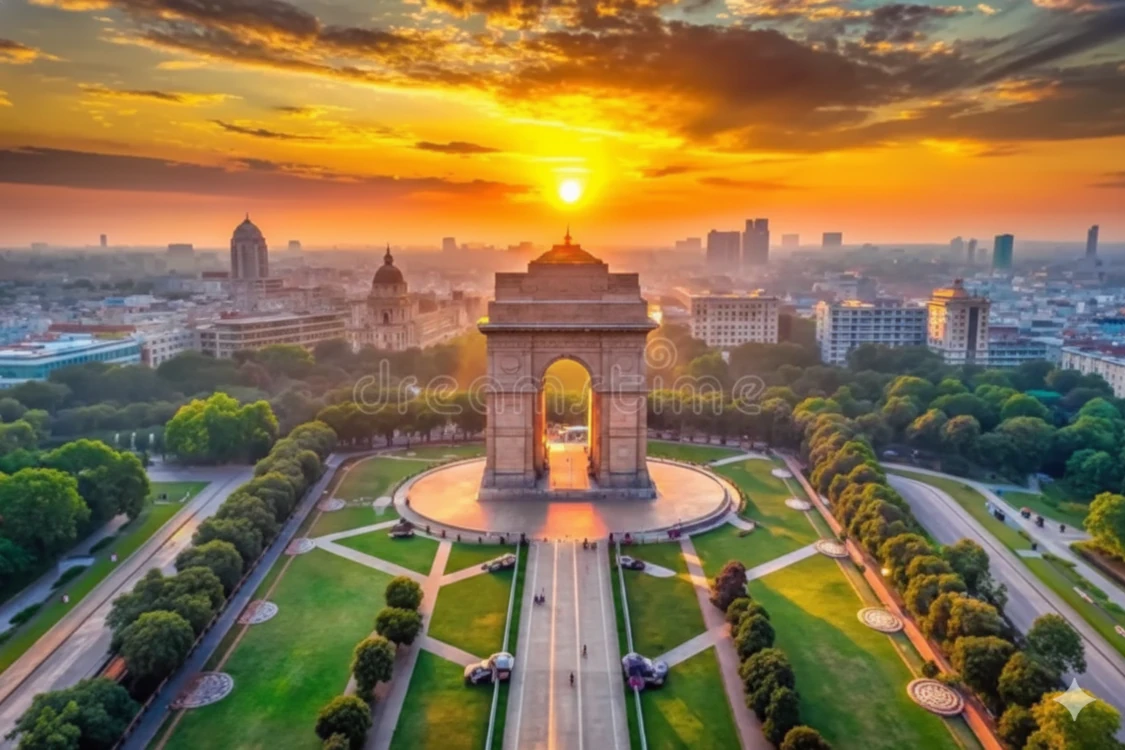
“For ‘Akhand Bharat’ to come into being, it has to be conceived as a multicultural, multiracial, multiethnic, multi-religious entity centred on the landmass of the Indian subcontinent and the adjoining seas, exercising global influence.”
Misconceptions & Misapprehensions
There are currently considerable misconceptions and misapprehensions about the concept, feasibility, and way forward for the realisation of an Akhand Bharat. Hopefully, as we broach the subject without prejudice or personal bias, most or some of these aspects shall become clearer.
It is indeed unique that an idea which envisions a united India, is derided as an impractical dream, fails most scholastic parameters to bear serious scrutiny, gets berated as a divisive force out to wreck the very nation that it proposes to amalgamate as one entity should set the alarm bells ringing amongst its internal as well as external detractors.
‘Akhand Bharat’ is not a call to consolidate India as a ‘Hindu Rashtra’. Recognising the presence of thirty million citizens of different faiths, the strength of India lies in its ‘diversity of populace with a unity of purpose,’ inspiring pride and hope among the audience.
Nor can ‘Akhand Bharat’ arise through force of arms. India lacks the strategic might and geopolitical influence to impose its sway over neighbouring lands, or the economic wherewithal to sustain the forced incorporation of those territories.
Therefore, the idea of ‘Akhand Bharat’ does have daunting proportions. The present has no comparable dimensions with the past. The geography of the Indian landmass was different; the culture, science, and even the way of life, as well as people’s thought processes, of those times were different.
An Opaque Prism
Various intangible and quantifiable elements will play a role in the outcome of the journey toward realising the idea. While the latter can be rationally assessed, more often it is the intangibles that dictate outcomes in the volatile, uncertain, complex, and ambiguous (VUCA) geopolitical environment the world has entered.
The rapid rise and equally swift collapse of Napoleon’s France, Nazi Germany, and the Communist USSR are catalyst geopolitical events that went unforeseen by geopolitical think tanks. Closer to India, the recent dramatic regime collapse in Bangladesh and Nepal caught the Indian strategic community off balance. The volatility and instability induced by policy flux and the transactional approach adopted by POTUS Donald Trump within the US, and globally among its friends and foes alike have made extrapolating geopolitical outcomes highly unpredictable.
In the current potpourri of the Indian polity, it is realistic to assume that there will be millions of dissenting voices within the idea of ‘Akhand Bharat’. But if the vision is for the greater good and pulses in the beat of a billion hearts, then a democratic polity does offer ways and means to construct a consensus around it, or at the very least, craft acquiescence to its implementation.
Yes, we come across as a seriously divided polity, and there are critical, quantifiable gaps that hinder our resurgence on the global stage. But India’s adversaries do not have the luxury of operating at their peak strength either.
Our major adversaries and ‘frenemies’ are currently in a state of geopolitical and geoeconomic overreach and are afflicted with internal divides of a greater magnitude than India faces. China’s apex military leadership is in disarray, a silent power struggle in the ruling political elite is in full steam, and its energy security is under threat. The US internal politics is deeply fissured, with people in the streets in major cities; its economy is under stress, with a 123% debt-to-GDP ratio, and its external alliances are fractured. In the minor league, Pakistan as a nation is reduced to the status of a supplicant to foreign aid donors, with open rebellion in the outlying provinces. What and who breaks first is the most engaging question.
In such turbulent times, leadership will be crucial. Handling the Economy, Military Potential, and China, along with a resolute leadership quotient and assertive mindset, will empower India’s rise toward ‘Akhand Bharat’, fostering confidence in the audience.
The Journey Ahead
It will be a long journey, spanning three to four decades, requiring patience and perseverance. The success of ‘Akhand Bharat’ depends on how nationalist leadership guides this generational effort, inspiring resilience and commitment in the audience.
Power of Narrative
Building a compelling ‘Power of Narrative’ around ‘Akhand Bharat’ is crucial; it must evolve from cultural ideals like ‘Vishwaguru’ and ‘Vasudeva Kutumbakam’ into a force of assertive national strength.
Pax Britannica, White Man’s Burden, Lebensraum, ideological struggle between Communism and Democracy, alongside the US Monroe Doctrine, Brezhnev/Primakov Doctrine of USSR/Russia, and the Eleven (erstwhile Nine) Dash Line of China, are relevant examples of ideological narratives floated to establish the global spheres of influence of the dominant global powers.
Pacifism to Assertive Mindset
The first and foremost step towards realising an ‘Akhand Bharat’ shall be overcoming the pacifist mindset that permeates the body politic of India. This frame of mind was fostered by design, by the foreign regimes that ruled over India for centuries.
It shall involve an intense and sustained national effort to bring about a civil society temperamental change from ‘ahimsa parmo dharam’ to ‘Vir bhogya Vasundhara’. That the current national leadership is aware of the critical need to effect this change is evident from the policy measures already underway to expedite the process…
Giving a fillip to ‘Nari Shakti’ (Women empowerment) through entry into the armed forces and women gender specific entrepreneurial schemes…
Introducing ‘Agniveer’ (short military service) scheme to permeate civil society with military-trained manpower…
Opening up the private sector for ‘Sainya Atamnirbharta’ (military self-reliance) …
Reorienting the national defence architecture through Theatre Command reforms and absorption of new-age war-fighting technologies…
The success of ‘Operation Sindoor’ highlights the efficacy of the reforms being instituted. There have been shortfalls, too, as some of these transformative policies have been mired in controversy. This fault has to be squarely assigned to a lack of vigorous political oversight and undue haste in bureaucratic policy formulation and execution; a right path in the wrong direction that shall necessitate an inevitable mid-course correction!
Identifying the Contours of ‘Akhand Bharat’
This is the most contentious space in envisioning an ‘Akhand Bharat,’ given the geopolitical realities.
Exploring an innovative hybrid union of geographical sovereignty, economic entity, and cultural fusion shall need to be developed under the overarching umbrella of ‘Akhand Bharat’ security.
However, the aversion of East Asian countries to this idea needs to be factored in, as they were on the receiving end of the enforced participation in Japan’s ‘Greater East Asia Co-prosperity Sphere’ during the Second World War!
Moving Beyond Terrestrial Boundaries
Going beyond the earth to colonise extraterrestrial space shall have to be integral to the resolve of ‘Akhand Bharat’, for that is where the future boundaries of the powerful nations shall expand. Orchestrating the technological shift to dominate extraterrestrial space shall involve…
Investing in new age technologies to explore and dominate extraterrestrial space…
Supporting the creation and rise of India’s own supra-national corporations for the race to colonise space…
Legislative intervention to facilitate the creation of Private Military Contractors (PMC)…
Incorporating the Armed Forces in the Journey to ‘Akhand Bharat’
The idea of promoting an ‘Akhand Bharat’ is too precious to be left to political and/or religious ideologues. Such a course is bound to raise fruitless ideological conflicts within the body politic, leading to delays or deviations that may dilute the achievement of the desired end state.
The Indian armed forces today are the most effective bastion of a homogenous India, with a pan-India, multicultural, multi-religious, multiethnic, multilingual profile.
Even more critical is the trust factor, wherein they top the trust scale in public thought. Supporting the vision of an ‘Akhand Bharat’ would come naturally to its leadership. Incorporating the armed forces into this movement shall also restore them to their lost prominence in the politico-bureaucratic inter-relationship.
Synthesising the Approach
Cross-debating the idea in open forums is the best way to broaden the alignment of the citizenry with the vision of an ‘Akhand Bharat,’ smoothening the path for evolving consensus and identifying measures to overcome infirmities encountered en route.
“The ‘third rising’ is not fully predicated on the outcome of quantifiable parameters that make or break ‘Great Powers’. While these parameters do matter, the intangible play of the ‘Shaktis’ (Energies) has a powerful role in orchestrating favourable global dynamics!”