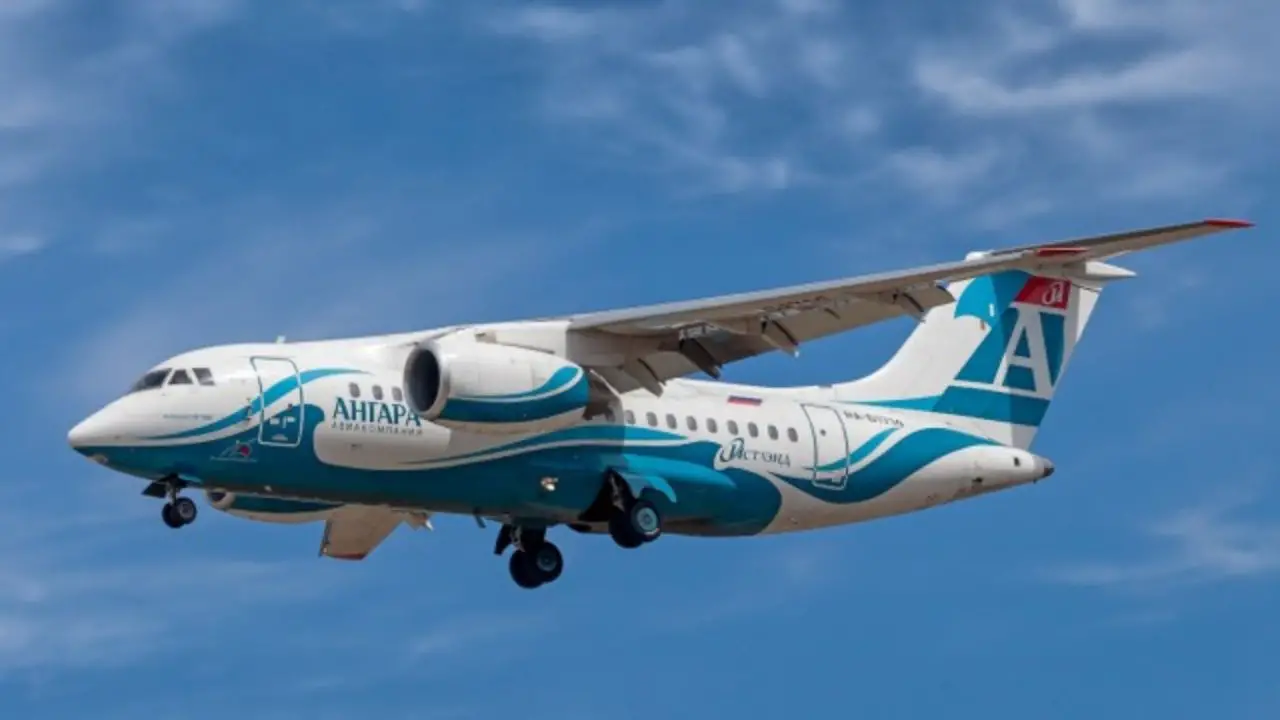
Russia has quietly initiated a program to refurbish and redeploy older aircraft from storage, representing a pragmatic response to sanctions, disrupted supply chains, and sustained pressures on domestic air transport capacity. Among the aircraft types now being returned to service is the Antonov An-148, a regional jet that had largely disappeared from commercial use over the past decade. Recent Russian reports suggest that multiple An-148 aircraft, previously stored for extended periods, are undergoing refurbishment and technical upgrades before being restored to operational condition for deployment by airlines and government operators.
This initiative is not depicted as a revival of serial production, but rather as an attempt to restore operational aircraft in the shortest feasible timeframe. The An-148, notwithstanding its complex history and mixed reputation, provides a balance of range, passenger capacity, and rough-field performance that aligns with Russia’s immediate requirements, particularly on regional and remote routes.
Why the An-148 is being brought back now
The reintroduction of the An-148 should be viewed within the wider context of Russia’s civil aviation landscape. In recent years, access to Western-manufactured aircraft, spare parts, and maintenance services has been significantly limited. Simultaneously, domestic aircraft initiatives such as the SJ-100, MC-21, and Il-114-300 remain in different phases of testing, certification, or initial production and are not yet capable of wholly substituting the current fleet in terms of quantity.
In this context, aircraft currently located within Russia, even if manufactured years before and stored, constitute a valuable asset. The An-148 aligns with this rationale. Several aircraft frames were preserved following their decommissioning, and these aircraft can be restored more rapidly and at reduced expense compared to building entirely new units. Engineers participating in the program are reported to have conducted comprehensive inspections, extensive overhauls, and system replacements to ensure that the aircraft comply with current airworthiness standards as mandated by Russian regulations.
The program prioritizes practicality over ambition. Rather than seeking to recommence international cooperation or reconstruct the original supply chains, the emphasis is placed on adapting the aircraft to available domestic resources, including locally supported components and revised maintenance procedures.
General features of the An-148
The An-148 is a regional jet intended for short- to medium-range flights with modest passenger demand, while providing jet-like performance and comfort. Depending on the interior configuration, the aircraft generally accommodates between 70 and 83 passengers in a single-class arrangement. This categorizes it definitively as a regional jet, appropriate for linking smaller cities to main hubs or for servicing thin routes where larger narrow-body aircraft would not be economically viable.
One of the distinctive characteristics of the An-148 is its high-wing layout paired with a T-tail. This design decision permits the engines to be mounted at a greater height above the ground, thereby decreasing the likelihood of foreign object harm and facilitating operations at airports with less-developed infrastructure. This capability has consistently been of particular significance for Russia, where numerous regional airports operate under demanding climatic and operational circumstances.
The aircraft is equipped with two turbofan engines from the D-436 family, delivering cruise speeds comparable to other regional jets and enabling the An-148 to operate efficiently over distances of several thousand kilometers, depending on the variant. Its range varies according to configuration, with extended-range models able to traverse interregional routes without the need for recharging.
Development and Preliminary History
The An-148 was designed in the early 2000s by the Antonov Design Bureau as a modern replacement for older Soviet-era short-haul aircraft, including the Tu-134. The objective was to develop an aircraft that integrates modern avionics and passenger comfort with the durability necessary for operation in challenging environments.
The aircraft conducted its inaugural flight in the mid-2000s and was subsequently introduced into service a few years thereafter. Production was organized both in Ukraine and in Russia, with licensed manufacturing at the Voronezh Aircraft Production Association. In principle, this configuration facilitated consistent production and a wide consumer base throughout the post-Soviet region.
Initially, the An-148 garnered attention from airlines seeking to modernize their antiquated regional aircraft fleets. Multiple variants were suggested, covering versions optimized for various ranges and payload capacities. Nevertheless, production figures remained modest, and the total number of aircraft manufactured never reached the levels initially projected by optimistic forecasts.
Operational expertise and encountered challenges
The service experience with the An-148 in Russia was varied. Although the aircraft exhibited commendable performance on routes with challenging runway conditions, initial operators reported concerns regarding reliability, maintenance complexity, and the availability of spare parts. These difficulties compromised dispatch reliability and elevated operational expenses, thereby eroding the confidence of airlines that were already hesitant to adopt a new aircraft type.
As diplomatic relations between Russia and Ukraine worsened, the situation grew increasingly complex. The An-148 depended on a supply chain that spanned multiple countries, especially for its engines and specific systems. As collaboration deteriorated, the maintenance of the aircraft became progressively more challenging. This resulted in many An-148 aircraft being withdrawn from commercial operations and subsequently reassigned to government operators or stored.
Despite these issues, the aircraft remained respected for particular functions, notably where its capacity to operate from shorter or less-prepared runways offered a distinct advantage over other regional jets.
Historical Service in Russia Before to the Revival
Prior to storage, the An-148 was operated by several Russian carriers on domestic routes. It was also used in government and specialized mission duties, where passenger comfort was subordinate to flexibility and range. Over time, however, fleet strategies evolved, and airlines preferred either larger narrow-body aircraft or foreign-produced regional jets equipped with more extensive global support networks.
By the late 2010s, the An-148 had essentially been phased out from standard commercial operations in Russia. The remaining aircraft were either minimally utilized or maintained in preservation, pending a determination regarding their future. At that point, few observers anticipated that the type would regain prominence.
The restoration process
The ongoing endeavor to reintroduce An-148 aircraft into service includes significantly more than only reactivating stored units. Engineers are reportedly substituting or adjusting systems that are no longer maintainable through the original supply channels. This involves labor related to avionics, onboard systems, and specific mechanical components. The objective is to guarantee that the aircraft can be maintained exclusively within Russia, without reliance on inaccessible foreign suppliers.
Each aircraft undergoes a comprehensive technical inspection, including structural assessments, engine maintenance, and test flights prior to being authorized for service. This procedure is labor-intensive; however, it enables operators to restore usable capacity in a relatively short timeframe compared to awaiting new aircraft deliveries.
The implications of the An-148’s return for regional aviation
For Russia’s domestic aviation sector, the reintroduction of the An-148 offers temporary relief. It enables airlines and government operators to sustain connectivity across regions, particularly on routes with reduced passenger demand or limited airport facilities. In practical terms, this can facilitate the stabilization of schedules and maintain access to air transportation for remote communities.
For passengers, the An-148 does not constitute a significant improvement in comfort or technology; however, it provides a sufficiently contemporary jet experience in comparison to much older aircraft that might otherwise serve the same purpose. Its return may also reduce pressure on larger aircraft, enabling more efficient usage on high-demand routes.
Is this a provisional measure or a permanent position?
Whether the An-148 will continue in service for many years or solely serve as a temporary solution depends on the pace at which Russia’s newer aircraft programs develop. Should domestic production of new regional and narrow-body aircraft accelerate, the An-148 may once again be discontinued as a transitional option. If delays continue, refurbished aircraft such as the An-148 may remain a significant component of the fleet for a lengthier period than initially projected.
It is evident that the aircraft’s return signifies a broader strategic emphasis on resilience and self-sufficiency. Rather than depending on unreliable external sources, Russia is using its existing resources, even if that entails reintroducing aircraft designs from a previous era.
In this context, the return of the An-148 is driven less by nostalgia and more by practical necessity. It emphasizes how technical expertise, industrial flexibility, and current assets are being utilized to maintain civil aviation amidst challenging circumstances.