


India’s security environment in 2026 demands urgent attention. Pakistan’s nearly 20 per cent increase in its defence budget and China’s steady 7.2 per cent growth underscore the pressing need for additional resources to address evolving threats along our borders and in the Indo-Pacific.
Operation SINDOOR in 2025 highlighted both strengths and gaps, reinforcing the necessity for strategic investment.
Against this backdrop, the National Democratic Alliance government’s defence record deserves a sober, balanced assessment. There is no doubt that the past decade has seen a structural shift in how India equips its armed forces. Indigenous production, private-sector participation, exports, and targeted modernisation have all moved in the right direction. At the same time, persistent issues, including low defence spending as a share of GDP, high pension liabilities, and procurement delays, continue to constrain operational readiness.
As the Union Budget for 2026 approaches, this article highlights key achievements and shortcomings, supported by complex numbers. It makes a compelling case that a 20 per cent increase in defence spending is essential to meet emerging threats and modernisation needs.
The Strategic Context: Why Defence Spending Matters More Than Ever
India’s defence planning can no longer afford incrementalism. The external threat spectrum is widening, not narrowing. Pakistan’s sharp budget hike is intended to restore conventional capability and sustain proxy warfare. China’s sustained spending growth supports long-term force modernisation, advanced missile forces, cyber and space capabilities, and rapid infrastructure build-up along contested borders.
Operation SINDOOR in 2025 demonstrated that India can respond decisively, but it also highlighted the cost of high-tempo operations. Ammunition stocks, air defence readiness, electronic warfare systems, and drone capabilities were stretched. These lessons cannot be ignored when allocating resources for 2026 and beyond.
The NDA Record: Key Gains Over the Past Decade
Indigenous Defence Production: A Structural Shift
One of the most significant achievements has been the surge in indigenous defence production, which should instill pride and confidence in India’s path towards self-reliance and strategic autonomy.
This growth is not cosmetic. It reflects a genuine shift in procurement philosophy. Indigenous systems now account for roughly 65 percent of domestic defence production, up from 30–35 percent in 2014–15. This change was validated during Operation SINDOOR, when locally developed systems, including battlefield surveillance and counter-battery radars, were deployed in real operational conditions.
The emphasis on Atmanirbhar Bharat has reduced import dependence, strengthened supply chain resilience, and shortened repair and maintenance cycles.
Defence Exports: From Tokenism to Scale
Defence exports were once an afterthought in India’s military-industrial ecosystem. In 2013–14, exports stood at a modest ₹686 crore. By FY 2024–25, they had surged to ₹23,622 crore, a 34-fold increase.
Equally important is who is driving this growth. The private sector now accounts for about 64.5 percent of defence exports, a clear sign that Indian companies are moving beyond licensed production to design, systems integration, and lifecycle support.
Exports do more than generate revenue; they foster quality standards and economies of scale, bolster India’s strategic influence with partner countries, and make them a vital component of national security and diplomacy.
Capital Outlay and Modernisation Push
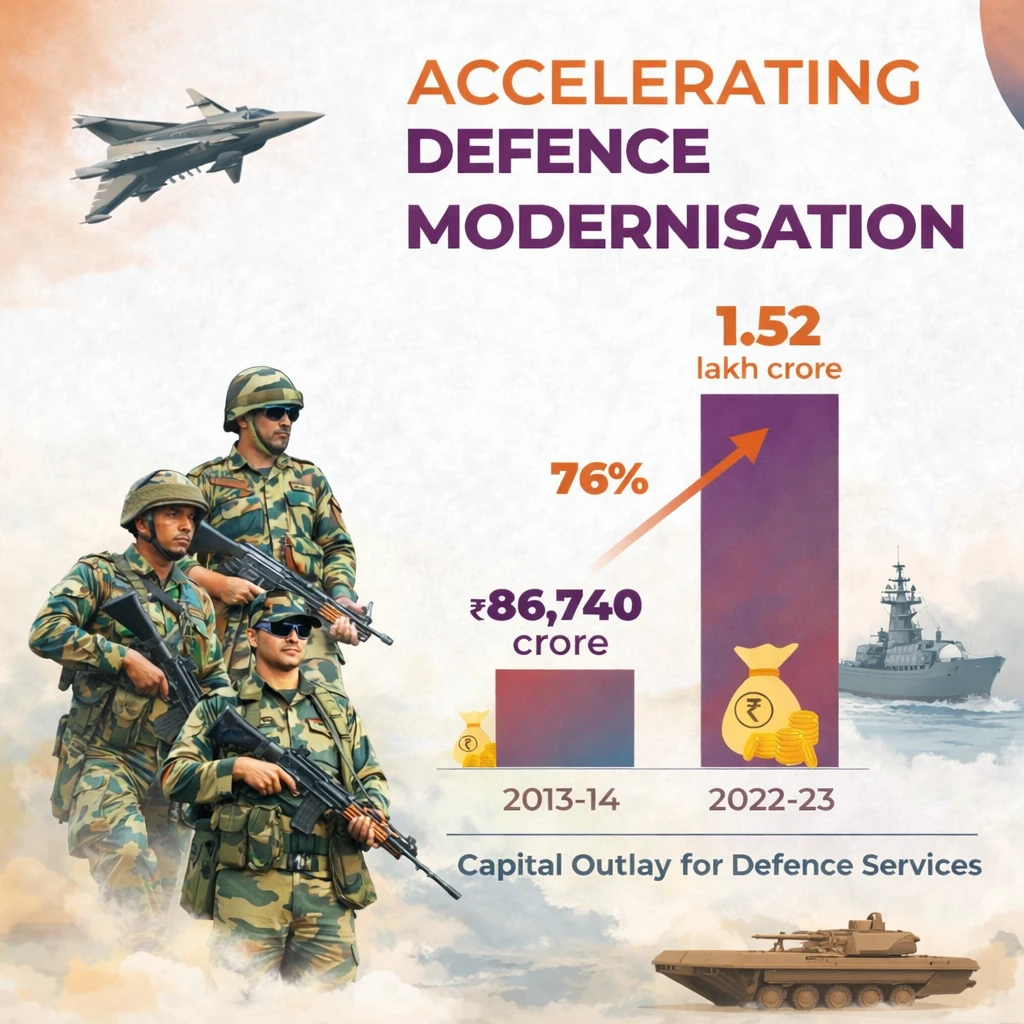
Capital outlay for the armed forces has grown steadily. In FY 2024–25, capital expenditure rose by over 20 percent from FY 2022–23 actuals, reaching approximately ₹1.72 lakh crore. By mid-FY 2025–26, about 51 percent of this allocation had been utilised, indicating improved absorption and execution.
This spending, which reached ₹6.81 lakh crore in 2025–26, underscores the need for a larger budget to sustain modernisation and maintain a strategic edge.
While this growth may appear modest, the composition of spending has shifted towards future-oriented capabilities rather than legacy platforms alone.
Persistent Shortcomings: Where the Model Falls Short
Defence Spending at 1.9 Per cent of GDP
Despite nominal increases, defence spending remains stuck at around 1.9 per cent of GDP. This falls short of the long-announced 2 per cent target and is increasingly inadequate in light of India’s threat environment.
Pakistan spends roughly 2 per cent of its GDP on defence, despite its smaller economy, while China’s lower GDP percentage masks a much larger absolute outlay. For India, remaining below the 2 per cent threshold sends mixed signals to both adversaries and partners about long-term preparedness.
Pensions and the Revenue Burden
Personnel costs and pensions continue to consume a disproportionate share of the defence budget. Pensions alone account for around 25 percent of total expenditure, or approximately ₹1.38 lakh crore, in recent years.
The impact of modernisation is severe. In the Army, only about 15 percent of equipment is classified as new. About 45 percent remains in the older generation category. This imbalance directly affects combat effectiveness, survivability, and sustainability during prolonged operations.
Capital Utilisation and Procurement Delays
Even when funds are allocated, utilisation remains a challenge. In the previous year, nearly ₹13,000 crore of capital funds went unspent due to procedural delays, trials, and contract finalisation.
While procurement reforms and faster decision-making are underway, the system still struggles to keep pace with the tempo required by modern warfare, especially in light of the lessons from Operation SINDOOR.
Revenue Expenditure Dominance
Revenue expenditure continues to dominate the defence budget, accounting for roughly 50–60 percent of total spending. Capital expenditure is constrained to around 25–30 percent, even though modernisation requires far higher investment.
This structural imbalance limits the pace at which new platforms, weapons, and technologies can be inducted.
What Budget 2026 Is Likely to Look Like
As of late January 2026, official figures are not yet available. However, analyst forecasts and recent trends indicate a double-digit increase in defence spending.
Capital outlay is projected to rise to around ₹2.3 trillion, up roughly 20 per cent year on year. This would push capital expenditure to about 26 percent of the total defence budget.
Research and development funding is also expected to grow, with allocations to defence R&D potentially increasing by ₹10,000 crore. This would strengthen efforts in advanced technologies such as artificial intelligence, cyber warfare, space systems, and hypersonics.
Focus Areas: Drones, Missiles, and Modernisation
Drones and Counter-Drone Systems
Unmanned systems proved decisive in Operation SINDOOR. As a result, Budget 2026 is expected to prioritise funding for combat drones, surveillance UAVs, and counter-drone systems.
Recent contracts for integrated counter-drone solutions and forecasts from financial analysts suggest that drone-related spending will be a key driver of capital expenditure growth. Indigenous Medium-Altitude Long-Endurance drones under Project Cheetah, with around 60 percent local content, are a prime example of this trend.
Missiles and Ammunition Replenishment
Missile forces and ammunition stocks are another priority area. Long-range air defence missiles, surface-to-surface rockets, and precision-guided munitions are expected to receive increased funding.
Post-Operation SINDOOR assessments have emphasised the need for sustained replenishment and faster production cycles, particularly for air defence and anti-radiation weapons.
Overall Modernisation
Modernisation spending is increasingly focused on electronic warfare, integrated air defence networks, and network-centric systems that link sensors, shooters, and decision-makers in real time.
In FY 2025–26, capital outlay stood at around ₹1.8 lakh crore, roughly 26.4 per cent of the total defence budget. Budget 2026 is expected to build on this trend, with an emphasis on systems rather than standalone platforms.
Indigenous Projects That Have Received Funding
Drone Programmes
Project Cheetah, valued at approximately ₹20,000 crore, aims to induct 87 armed MALE drones with indigenous subsystems and faster delivery timelines. Swarm drone capabilities are also being funded, with the Army clearing proposals worth around ₹5,000 crore for indigenous UAVs designed for saturation and electronic attack roles.
Engine development for unmanned combat aerial vehicles has received over ₹700 crore for Kaveri derivative programmes and technology demonstrators, supporting long-term autonomy in propulsion systems.
Missile Programmes
Several missile projects have been accelerated through development-cum-production models. The ULPGM-V3, designed for launch from indigenous UAVs, has progressed through trials with private-sector integration.
Project Kusha, with an allocation of around ₹21,700 crore, focuses on long-range surface-to-air missile systems to strengthen layered air defence. Emergency procurement lists released in 2025 included a wide range of missiles and precision weapons, ensuring rapid induction where operational gaps were identified.
These investments, routed through technology development funds and MAKE schemes, also support MSMEs and private innovation.
Why a 20 Percent Defence Budget Hike Is Necessary
A 20 percent increase in the defence budget is not a political slogan. It is a strategic necessity driven by three complex realities.
First, adversary spending is rising faster than India’s. Pakistan’s 20 percent increase and China’s steady increases will create capability gaps if India remains below 2 percent of GDP.
Second, Operation SINDOOR exposed the cost of sustained high-tempo operations. Air defence, drones, electronic warfare, and ammunition stocks require continuous investment, not episodic infusions.
Third, the modernisation backlog is real. With 70–75 percent of the budget absorbed by pensions and revenue expenditure, only a significant hike can free up ₹2.3 lakh crore or more for capital modernisation without destabilising other commitments.
Recommended Allocations for Budget 2026
To restore balance and confidence, India should aim for a total defence budget of around ₹8.2 lakh crore, a 20 percent increase.
Within this, capital modernisation should receive at least ₹2.3 lakh crore. Defence R&D allocations should rise by ₹10,000 crore, bringing them closer to 10 per cent of the overall defence budget.
Dedicated funding of around ₹50,000 crore should be allocated to indigenous drone and missile programmes, including MALE drones, swarm UAVs, long-range air defence systems, and precision-guided munitions.
Tax incentives and policy support for private industry and MSMEs can further accelerate innovation. A multi-year commitment of ₹1 lakh crore for border infrastructure, electronic warfare, and network-centric systems would consolidate the gains from Operation SINDOOR.
Conclusion: A Moment That Demands Resolve
The NDA government’s defence record is neither a story of unqualified success nor one of failure. It is a story of meaningful progress constrained by structural limitations.
Indigenous production, exports, and private-sector participation have transformed India’s defence ecosystem. Yet underinvestment relative to GDP, pension burdens, and procedural delays continue to constrain the pace of modernisation.
Budget 2026 is an opportunity to correct course. A decisive 20 percent increase would signal intent, reassure the armed forces, and send a clear message to adversaries that India is prepared to defend its interests with sustained capability rather than reactive measures.
In a challenging neighbourhood, caution has its place. But preparedness demands commitment. The time for half-measures has passed.