Wars are often studied in terms of how they begin force mobilization, launch corridors, and battlefield strategy dominate operational planning. Yet, history repeatedly shows that the most decisive phase of war is not the opening assault but the closing sequence. Victory is not determined solely by successful entry into hostile territory. It is determined by the ability to exit conflict with strategic objectives, such as political stability and regional security, intact, highlighting the need for integrated exit planning.
The selection of launch pads, movement corridors, and operational axes attracts intense attention during the planning phase of war. However, planning exit routes, disengagement mechanisms, and war termination criteria often receives less emphasis. This imbalance creates strategic vulnerability.
The harsh reality of warfare is straightforward: if the exit plan is unclear, the campaign itself becomes uncertain. And uncertainty leads to defeat.
Launch Without Exit: The Beginning of Strategic Failure
Military campaigns require clarity of purpose at three critical stages: entry, sustainment, and exit. Entry determines initial success. Sustainment ensures endurance. Exit determines the outcome. The failure to define exit criteria turns limited military objectives into prolonged engagements. Initial victories may generate optimism, but without a clear termination strategy, operational success is hard to translate into strategic achievement.
History provides many examples where military dominance failed to yield lasting success because exit planning was unclear. Forces have entered conflicts with well-defined tactical goals but lacked clarity on how these objectives would lead to long-term stability. When exit strategies are not clearly outlined, wars tend to drift. Drifting wars rarely lead to victory. Instead, they result in exhaustion.
The Three Dimensions of War Termination
Successful war termination depends on three interconnected dimensions: military, political, and logistical. Each dimension affects the feasibility of withdrawal or disengagement. The military dimension involves gaining enough battlefield advantage to prevent an immediate reversal after disengagement. Forces withdrawing from conflict must maintain the ability to deter renewed resistance.
The political dimension requires securing agreements or conditions that sustain stability beyond military withdrawal. Without a political resolution, battlefield success remains temporary. Effective exit planning must include diplomatic efforts to promote political stability, peace agreements, and regional cooperation, which are crucial for long-term success.
The logistical aspect involves ensuring supply continuity during disengagement. Withdrawal operations demand as much planning as offensive movement. Retreating under pressure without logistical coordination leads to chaos.
Failure in any of these areas causes instability. This instability fuels conflict, and prolonged conflict leads to greater losses.
Afghanistan: The Lesson of Delayed Exit
The campaign in Afghanistan remains one of the most instructive examples of the challenges of exit planning in modern warfare. Initial military operations achieved rapid success, yet long-term objectives evolved without clear termination criteria. Tactical victories accumulated, but strategic closure remained elusive. Over time, the absence of clearly defined exit conditions transformed the campaign into an extended commitment.
Logistics burdens increased financial costs accumulated. Political pressure intensified. Withdrawal, when it eventually occurred, required complex coordination across multiple domains: military redeployment, diplomatic negotiation, and infrastructure transition. The Afghanistan experience demonstrated that deliberate, early exit planning inspires confidence and reduces strategic vulnerability, reminding military strategists and policymakers of the importance of proactive preparation.
Iraq: A Different Exit — But Not Without Consequences
While the coalition victory in the Iraq War demonstrated decisive battlefield success, the region’s long-term stability remained contested. The rapid withdrawal of coalition forces after achieving limited objectives reflected disciplined adherence to defined termination goals.
However, subsequent conflicts within Iraq revealed the consequences of inadequate stabilisation planning. Military wins alone did not guarantee lasting stability. Achieving stability depends on political consensus, which in turn necessitates ongoing engagement. Without continuous planning, short-term victories can result in repeated conflicts. This highlights the crucial need to establish clear end-state goals prior to initiating military actions.
Iran: The Complexity of Withdrawal Under Pressure
Withdrawal under sustained missile and drone threats is highly complex, emphasising the need for meticulous planning to ensure safe and effective disengagement for military officers and strategists.
It presents operational challenges that surpass those encountered during offensive movements. Entry supply routes may become contested corridors during withdrawal, and damaged infrastructure may no longer support movement.
Vehicles are required to move forward while under fire. Personnel must evacuate promptly when under pressure. Recovering equipment in such situations becomes difficult.
In such conditions, orderly withdrawal requires overwhelming coordination across military, logistical, and diplomatic domains. This includes synchronised planning for movement, infrastructure recovery, and communication. Without meticulous coordination, withdrawal becomes retreat, increasing the risk of loss and strategic failure.
Without coordination, withdrawing can turn into retreat. When retreat happens under pressure, it leads to loss, and loss ultimately results in defeat.
Attrition and the Exit Threshold
Modern wars often reach what can be called an exit threshold a point where cumulative losses, resource depletion, and political fatigue come together, making further engagement unsustainable.
This threshold does not appear abruptly; it forms over time. Equipment attrition diminishes operational capacity, while logistical pressures lead to supply shortages. Personnel fatigue hampers combat effectiveness, and political pressure heightens the urgency of decisions. Ultimately, continuing becomes more costly than disengaging, making withdrawal unavoidable. However, inevitability alone does not ensure success. A successful withdrawal demands proper preparation, as an unplanned exit can result in chaos, which in turn causes losses.
Infrastructure Vulnerability During Exit
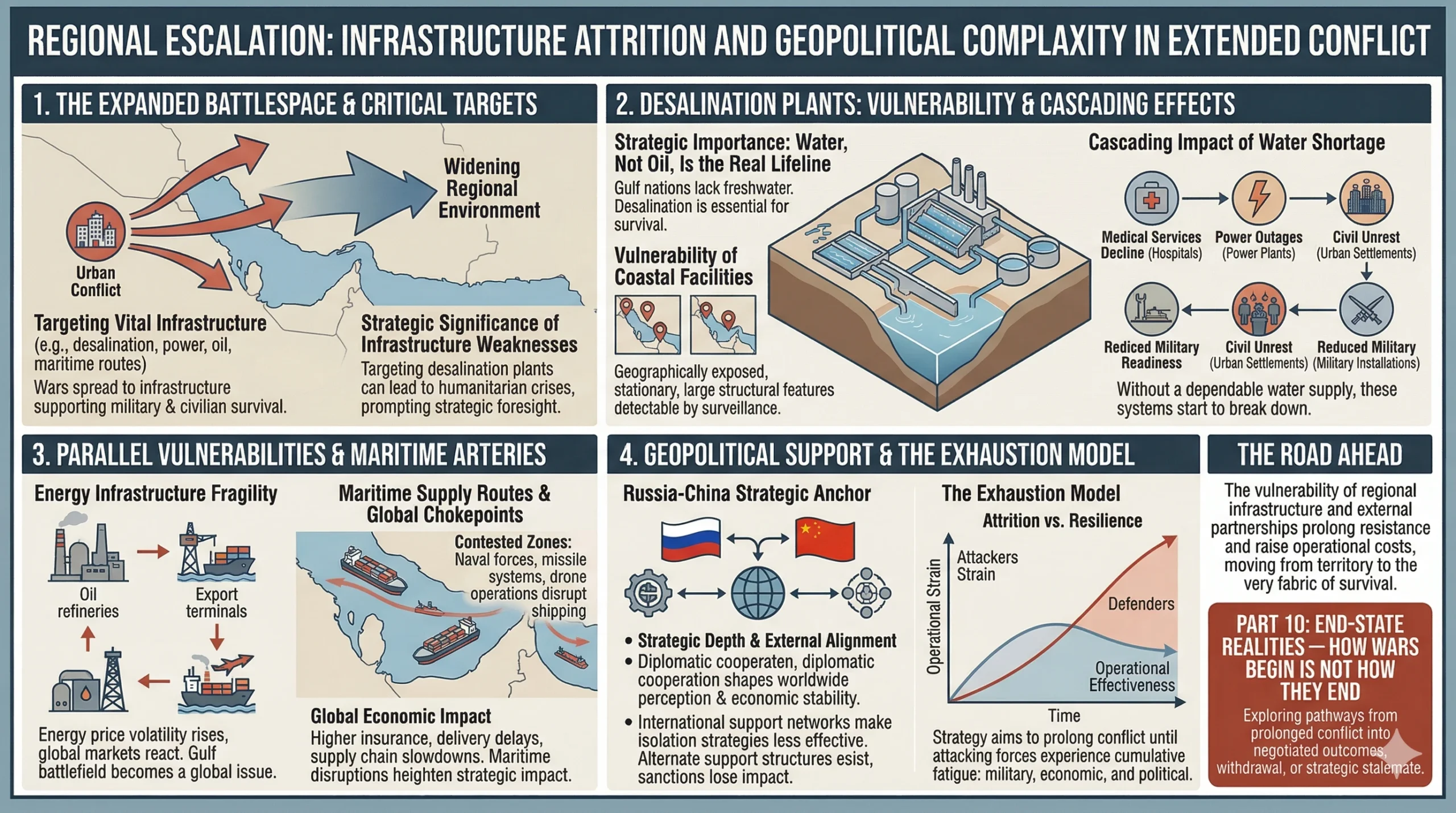
As discussed in Part 9 of this series, regional infrastructure is a crucial vulnerability during prolonged conflict. During withdrawal phases, this vulnerability becomes even more severe. Defenders might increase attacks on infrastructure to hinder disengagement efforts.
Desalination plants, energy facilities, and transportation hubs become strategic pressure points. Disrupting these systems during withdrawal raises humanitarian concerns and complicates military coordination.
Supply shortages arise. Communication networks deteriorate. Evacuation efforts are sluggish. Withdrawal timelines are prolonged. Longer timelines heighten vulnerability. This cycle turns disengagement into a wearisome retreat.
The Psychological Dimension of Exit
Exit operations impose significant psychological stress on both commanders and troops. During a withdrawal, disciplined execution is essential, especially under uncertain conditions. Units must remain cohesive even when they feel disengaged.
Morale has a major impact on operational results; high morale helps keep order, whereas low morale leads to faster disarray. This disorganisation makes units more vulnerable. Hence, psychological resilience is just as crucial as tactical coordination during withdrawals. History shows that disciplined withdrawals preserve combat effectiveness, while chaotic retreats tend to cause it to be lost.
The Role of External Actors in Exit Dynamics
In prolonged conflicts, external actors influence the outcomes of exits. As discussed earlier, nations such as Russia and China may provide indirect support that sustains defensive endurance. Their involvement affects negotiation dynamics and determines the duration of conflict. External support networks bolster defensive resilience, making rapid disengagement more difficult. Diplomatic negotiations tend to be prolonged. Military operations often continue during negotiation phases. This extended engagement increases operational strain. Strain accelerates fatigue, and fatigue leads to withdrawal decisions. Therefore, the presence of external geopolitical alignment influences not only battlefield conditions but also the timing and structure of exit operations.
Victory, Stalemate, or Withdrawal: The Three Possible End States
All military campaigns eventually lead to one of three outcomes: decisive victory, prolonged stalemate, or negotiated withdrawal.
A decisive victory demands overwhelming superiority, sustained logistics, and favourable terrain. As established throughout this series, such conditions are difficult to achieve in Iran.
A prolonged stalemate occurs when neither side gains a decisive advantage. Attrition continues, costs mount, and political patience wears thin.
Negotiated withdrawal occurs when maintaining engagement is no longer strategically viable, with diplomatic solutions replacing military action. This outcome is most common in prolonged attrition conflicts. However, it does not signify defeat unless it occurs in chaos. Maintaining order ensures survival, while disorder leads to defeat.
The Strategic Value of Exit Planning
Exit planning must begin before the first shot is fired. Military planners must define not only how to enter conflict but also how to disengage from it under multiple scenarios.
Exit criteria should encompass achievable military objectives, defined operational timelines, logistics withdrawal strategies, diplomatic negotiation frameworks, and stabilisation mechanisms. Without such detailed planning, campaigns risk becoming unpredictable. Predictability allows for effective planning. Planning ensures survival. Survival ultimately determines the outcome.
The Final Lesson: Entry Is Tactical — Exit Is Strategic
Choosing launch pads affects tactical options, while planning exit routes impacts strategic survival. This key difference is a core lesson in modern warfare. Wars aren’t lost at the entry point; they’re lost when the exit fails. Not planning for an exit turns early victories into eventual defeats. Defeat isn’t always about battlefield loss—it’s when withdrawal becomes necessary and uncontrollable.
The Strategic Synthesis of This Series
Throughout this series’ ten sections, we explored the complex layers of a hypothetical ground campaign against Iran. We considered terrain constraints, restricted entry routes, logistics challenges, lack of coalition support, urban combat difficulties, infrastructure weaknesses, and geopolitical factors.
Each element shapes the overall operational environment.
Iran’s geography favours defenders, while infrastructure weaknesses extend conflict beyond the frontlines. The absence of coalition support diminishes operational strength, and urban warfare increases attrition. External support networks can delay the resolution of the conflict. Collectively, these factors create a battlefield more about endurance than manoeuvring. Ultimately, endurance benefits the defenders.
The Final Word
Military campaigns often start with momentum but conclude with consequences. Success depends not just on a strong beginning, but also on a clear end. Choosing the right launch point sets the tone at the start. An effective exit plan determines how the conflict concludes. Neglecting to plan an exit can result in loss, which in turn leads to defeat. When defeat occurs, it permanently alters the strategic landscape for years to come. This crucial lesson from history highlights the importance of planning. It serves as a warning that should never be overlooked.