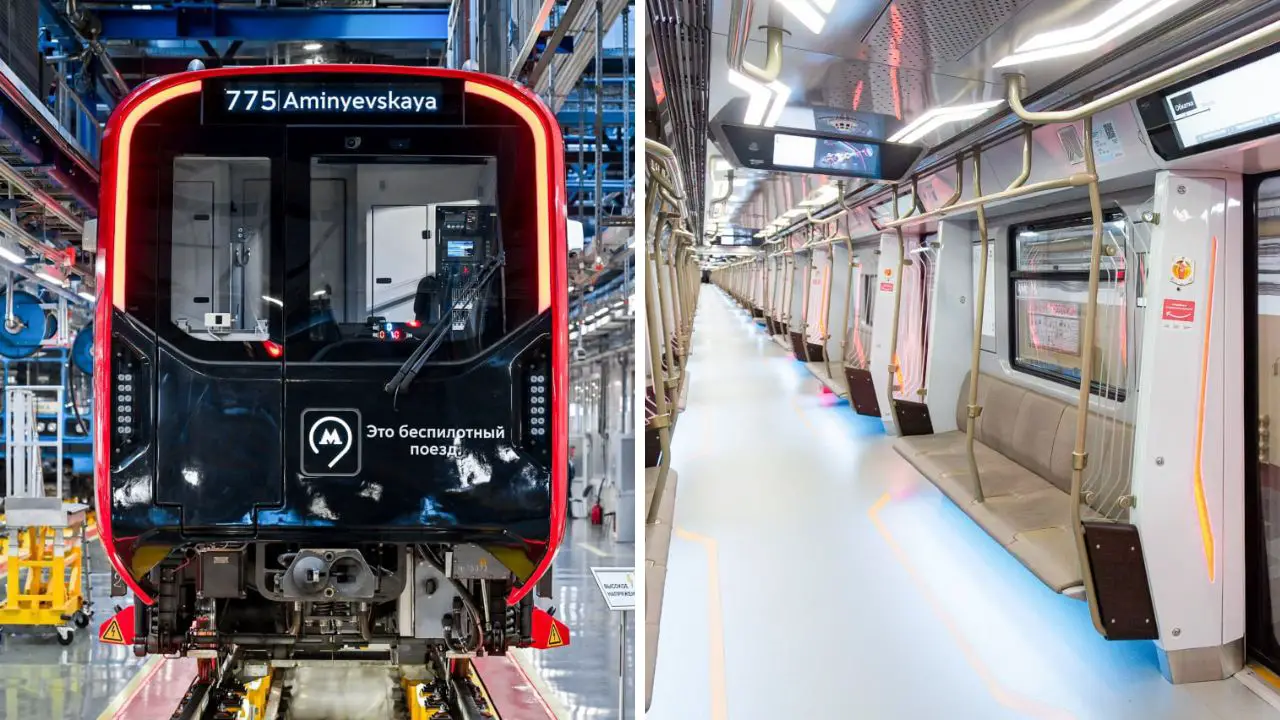
Russia has officially started a new phase in urban transportation through the start of testing for the nation’s debut unmanned metro train. The project, launched in Moscow, signifies a notable technological achievement and positions Russia within an expanding group of nations exploring wholly automated mass transit systems. The testing phase has commenced on the Bolshaya Koltsevaya Line, one of the newest and most sophisticated lines of the Moscow Metro, using a specially equipped train designated as “Moscow-2024.”
The experiments are presently carried out during nighttime hours and without passengers, enabling engineers and transportation authorities to assess the system under authentic operating conditions while mitigating any potential risks to public safety. These trials represent the initial practical measure toward implementing completely autonomous metro services in Russia’s largest city and ultimately throughout the network.
The Strategic Significance of the Bolshaya Koltsevaya Line
The Bolshaya Koltsevaya Line, commonly known as the Big Circle Line, was intentionally chosen for the initial autonomous testing. As one of the most modern sections of the Moscow Metro, it is outfitted with state-of-the-art signaling, communication, and monitoring systems. These attributes render it an excellent environment for evaluating autonomous technology.
The line is essential for the redistribution of passenger volumes throughout the metro system and functions at a high frequency. Testing unmanned trains within such an environment enables developers to assess whether autonomous systems can effectively manage real-world metro conditions, including accurate station stops, narrow headways, and coordination across multiple intersecting lines.
The “Moscow-2024” Train: A Demonstration Platform for Autonomous Technology
The Moscow-2024 train functions as the primary testing platform for autonomous operations. Although it bears a visual resemblance to traditional metro rolling stock, it has been outfitted with sophisticated onboard computers, sensors, and communication modules that enable autonomous operation without direct driver intervention.
During testing procedures, the train autonomously executes all essential operational functions. These comprise acceleration from stations, speed regulation throughout the route, precision braking, station stops, and the opening and closing of doors. All activities are regulated by software algorithms engineered to emulate and, in certain instances, exceed the consistency of human performance.
Currently, the emphasis is placed on stability, predictability, and fault tolerance, rather than on pace or capacity. Engineers are meticulously observing the train’s response to various operational scenarios, encompassing changes in track conditions, signaling inputs, and timing constraints.
Software as the Foundation of Unmanned Operation
The core of the unmanned metro project lies in the software infrastructure created by experts from the Moscow Government’s Center for Research and Development of Unmanned Vehicles. Instead of depending on a single control program, the system comprises multiple interconnected modules operating concurrently in real time.
A single module oversees train dynamics, precisely controlling traction and braking functions. Another manages interaction with infrastructure by receiving data from trackside equipment, station systems, and signaling devices. Additional modules oversee scheduling and dispatching, guaranteeing that the autonomous train integrates smoothly into the existing metro timetable.
Crucially, the system is completely integrated with the central traffic management system of the Moscow Metro. This integration enables the autonomous train to sustain standard traffic intervals, adapt its pace according to network conditions, and prevent conflicts with conventionally operated trains traveling on the same line.
Nighttime Testing and Safety Procedures
All ongoing testing is performed during nighttime hours, when passenger traffic is not present. This methodology is a conventional practice in prominent rail automation initiatives globally and enables engineers to evaluate the system across a broad spectrum of test scenarios without the constraints of operational pressure.
Although designated as “unmanned,” the testing phase continues to require significant human supervision. Control center personnel observe the train’s operations in real time, while engineers scrutinize extensive data produced during each journey. Any anomalies, regardless of their magnitude, are documented and analyzed to enhance the software and hardware configurations.
This prudent, incremental approach embodies the recognition that public confidence in automated transportation must be established through proven reliability rather than swift implementation.
Transition to the Moscow-2026 Train
While the “Moscow-2024” train functions as the inaugural test vehicle, the subsequent significant phase of the project will feature a newer generation train designated as “Moscow-2026.” This model is being designed specifically for unmanned operation, rather than being adapted from an existing design.
The Moscow-2026 train is expected to incorporate advanced onboard computing capabilities, enhanced sensor arrays, and more comprehensive integration with metro infrastructure systems. It will likewise incorporate lessons learned during the initial trial phase of the “Moscow-2024,” including enhancements to both hardware and software.
Testing of the “Moscow-2026” is scheduled to commence as the project advances, with the objective of deploying a fully operational unmanned train capable of continuous operation under standard metro scheduling conditions by the conclusion of 2026.
Roadmap for Passenger Service Development
In accordance with the project timeline, the implementation of autonomous metro operations will proceed through a phased approach. Following the end of nighttime and passenger-free testing, unmanned trains will commence more frequent operations within the metro timetable, still without passengers.
The next major milestone is the commencement of passenger service, anticipated to occur in 2027. Initially, these trains may operate concurrently with traditional services and may be staffed with onboard personnel to provide reassurance and emergency support, despite the drive functions remaining automated.
The main objective is to develop a metro line featuring fully autonomous trains that operate continuously, transporting passengers as part of the standard service. By 2030, Moscow intends to inaugurate its inaugural entirely automated metro line, signifying the culmination of years of technological advancement and organizational refinement.
Capacity and Operational Features
The autonomous trains currently in development are engineered to accommodate the high capacity requirements of the Moscow Metro. The updated train configurations are anticipated to comprise eight carriages and have the capacity to transport approximately 1,500 passengers per train.
With dimensions comparable to those of extant metro rolling stock, these trains are designed to integrate seamlessly into current station layouts and platform configurations. Automation is not intended to decrease capacity or service frequency; rather, it is designed to facilitate more accurate scheduling and potentially increase throughput during peak periods.
Why Automation Matters for Moscow
The deployment of driverless metro trains is not solely a technological trial. It is a component of a comprehensive strategy to modernize Moscow’s transportation infrastructure, enhance operational efficiency, and facilitate sustainable long-term development.
Automation provides the opportunity for more reliable train operations, diminished human error, and enhanced energy efficiency. In a complex system such as the Moscow Metro, where trains operate with very brief intervals, even minor enhancements in precision can substantially influence overall efficiency.
Furthermore, the domestic development of such technology enhances Russia’s proficiency in sophisticated transportation systems and diminishes dependence on foreign solutions.
Part of a Broader Autonomous Transport Push
The unmanned metro project is consistent with broader initiatives in Russia to implement autonomous technologies within public transportation systems. Moscow has already conducted trials with autonomous trams that operate based on similar principles of automated control and centralized oversight.
At the national level, autonomous rail technologies are also undergoing testing in suburban and industrial rail operations. Together, these initiatives exemplify a coordinated strategy for automation spanning various modalities of transportation rather than isolated trials.
Future Perspectives
The demonstration of Russia’s inaugural unmanned metro train signifies a pivotal milestone for urban transportation within the nation. What initially started as controlled nighttime demonstrations on a single line is expected to develop into a fully operational, passenger-carrying system within a few years.
If successful, the initiative will establish Moscow as one of the top cities globally in automated metro technology. More importantly, it will demonstrate that extensive, intricate, high-capacity metro networks can shift to autonomous operation without sacrificing safety or reliability.
As testing progresses and the technology advances, the unmanned metro train may soon transition from an experimental anomaly to a routine aspect of daily life in Moscow—subtly transforming the way millions of residents navigate the city.