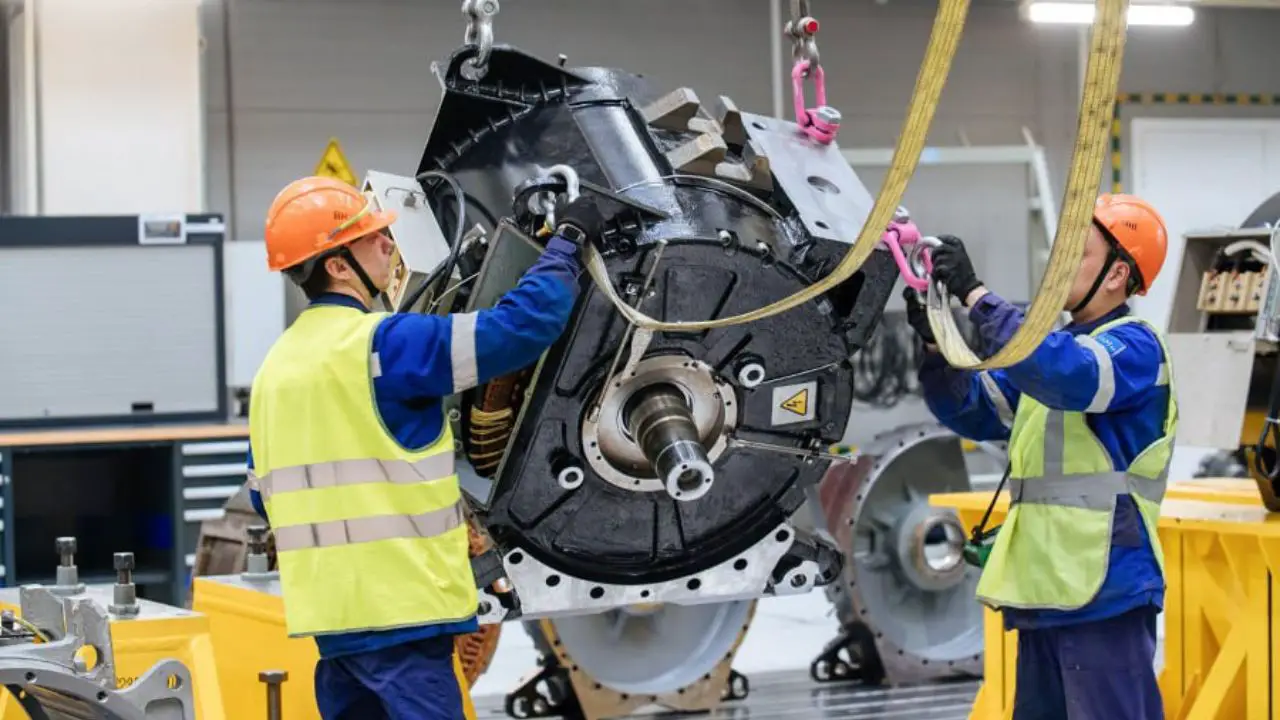
In mid-January 2026, Russia announced the successful completion of bench tests for a new traction asynchronous electric motor intended for next-generation high-speed trains. The motor, designated TAD-650, signifies a major achievement in the development of domestic rolling stock technologies and denotes an important progress toward technological independence in the domain of high-speed rail transportation.
The project demonstrates that Russia is now capable of independently designing and producing one of the most vital components of a modern high-speed train—the traction system—at a standard comparable to that of the world’s leading manufacturers.
A New Era in Russian Rail Engineering
The TAD-650 traction motor was designed by Russian Electric Motors, a corporation headquartered in Chelyabinsk and integrated into the industrial ecosystem of Transneft. The main objective of the program was to develop an entirely domestically produced traction motor suitable for high-speed passenger trains designed to operate at speeds of up to 360 km/h.
Based on the bench testing results carried out in early January 2026, the developers verified that the motor’s operational efficiency and energy performance are comparable to the leading international counterparts presently used by high-speed rail systems globally.
This represents an important milestone, as the traction motor constitutes the basic component of any electric train. Its performance directly influences acceleration, cruising ability, energy efficiency, reliability, and overall operational expenses.
Configuration and Implementation in High-Speed Rail Systems
Each high-speed trainset fitted with the TAD-650 will employ 16 traction motors. The design envisions the implementation of powered bogies in four vehicles—specifically the first, third, sixth, and eighth cars—each equipped with two motorized bogies. The remaining vehicles employ non-powered wheelsets.
Despite its high output, the TAD-650 remains compact and lightweight relative to high-speed rail standards. The motor has an approximate weight of 750 kilograms and provides a power output of 650 kilowatts, with an efficiency of approximately 96 percent. Such attributes are especially critical for high-speed trains, where minimizing mass and optimizing efficiency have a direct impact on performance and energy consumption.
Engineered for 360 km/h Performance
The TAD-650 was developed specifically for next-generation high-speed trains, with a designated operating speed of 360 km/h. This places the future Russian platform in the same category as the fastest European and Asian high-speed trains.
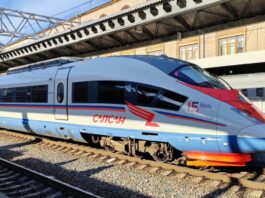
For comparison, each traction motor employed in Russia’s current premier high-speed train, the Siemens Velaro RUS (Sapsan), generates approximately 510 kW. The increased per-motor output of the TAD-650 enables designers to achieve greater overall traction power while preserving flexibility in train configuration.
The motor uses a three-phase asynchronous design featuring a squirrel-cage rotor, a proven and dependable configuration commonly found in modern high-speed rolling stock owing to its durability, consistent performance, and extended operational lifespan.
Import Substitution and Local Manufacturing
One of the key features of the TAD-650 program is its complete localization within Russia. The motor is manufactured by using Russian components and materials as part of a comprehensive national import substitution initiative.
The first prototype was produced in 2024, with acceptance and qualification testing conducted throughout 2025. By early 2026, the motor had achieved preparedness for mass production, with manufacturing processes being expanded at the Chelyabinsk facility.
The condensed development schedule underscores both the urgency of the project and the extent of industrial mobilization required. In a setting characterized by sanctions and limited access to foreign technologies, the capacity to produce such a complex component domestically holds substantial strategic importance.
High-Speed Rail Development in Russia
The development of the TAD-650 is intricately connected to Russia’s wider strategic objectives in high-speed rail infrastructure. The signature project is the Moscow–Saint Petersburg High-Speed Railway, which is anticipated to decrease the travel duration between the two cities to roughly 2 hours and 15 minutes.
Test runs of the new rolling stock are scheduled for 2027, with commercial operations anticipated for 2028. The project represents one of the most significant infrastructure initiatives in contemporary Russian transportation history and is anticipated to generate considerable economic and social advantages.
A domestically manufactured traction motor is a crucial requirement for such a project, guaranteeing long-term maintainability, secure supply chains, and independence from foreign producers.
Comparison with Western Industry Leaders
The main point of comparison for the TAD-650 is the traction system used in the Siemens Velaro series of trains, including the Velaro RUS currently in service in Russia.
Although the Velaro platform is a well-established and reliable system, its individual traction motors are typically rated at lower power levels compared to the TAD-650. This indicates that the Russian motor provides a greater power density per unit, which is beneficial for attaining higher design velocities and enhanced acceleration characteristics.
Western manufacturers, however, are progressively adopting permanent-magnet synchronous motors, which provide greater power density and potentially enhanced efficiency relative to asynchronous configurations. These technologies are anticipated to be incorporated into future iterations of European high-speed trains, including Siemens’ forthcoming Velaro Novo platform.
Nevertheless, asynchronous motors continue to be highly regarded for their robustness, straightforward maintenance, and consistent performance, rendering the TAD-650 a highly competitive option for present operational demands.
Engineering Importance and Strategic Significance
The effective development of the TAD-650 exemplifies Russia’s ability to independently design and produce essential high-technology components for sophisticated transportation systems. Until recently, high-speed rail operations in Russia depended significantly on foreign suppliers, especially in the provision of traction apparatus.
With the TAD-650, Russia establishes the groundwork for entirely domestically produced high-speed train platforms, decreasing reliance on external vendors and enhancing resilience against geopolitical threats.
Beyond domestic application, such advancements may ultimately facilitate export prospects, especially in markets seeking alternatives to Western and Chinese rolling stock providers.
Challenges and Prospects for the Future
Although the TAD-650 has achieved success, challenges persist. Integrating the motor into a comprehensive traction and control system capable of dependable performance at sustained velocities exceeding 300 km/h necessitates extensive testing under real-world conditions.
Furthermore, the level of competition within the high-speed rail industry continues to be vigorous. Organizations including Siemens, Alstom, and CRRC continue to develop power electronics, digital control systems, and energy-efficient solutions.
Nonetheless, the TAD-650 constitutes a robust initial foundation. It demonstrates that Russia has restored vital expertise in the design and production of propulsion motors—skills that are crucial for sustained success in high-speed rail development.
Final Remarks
The TAD-650 traction motor represents an important milestone in Russian rail engineering. As the nation’s inaugural serially manufactured traction motor specifically engineered for high-speed trains, it aligns with international standards in terms of power, efficiency, and operational performance.
More than merely a technical achievement, the TAD-650 represents a strategic transition toward greater self-sufficiency in advanced transportation technologies. It offers the technological foundation for Russia’s upcoming high-speed rail network and indicates the country’s readiness to compete in one of the most challenging sectors of contemporary transportation engineering.