

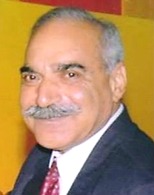
If Pandit Nehru, the prime minister; Krishna Menon, the defense minister; and BN Mullick, the intelligence chief, had heeded the cautions over China from General KS Thimayya, the then Chief of the Army Staff, instead of conspiring against him and rubbishing his advice, the country would have avoided an ignominious defeat, a colossal loss of lives, injuries to thousands, and international prestige in the 1962 Sino-Indian War. The Chinese inflicted significant losses on us, but the battles of Rezang La and Gurung Hill in Chushul, as well as those in Walong, Tawang, Namka Chu, and Nauranang (now named Jaswant Garh in Arunachal Pradesh), were pivotal. Giving asylum to the Dalai Lama and the ill-thought-out forward policy by Pandit Nehru, supported by his incompetent coterie of Menon, Mullick Thapar and Kaul, annoyed the Chinese leadership immensely, circumscribing the halo of the ‘Panch Sheel’ and ‘Hindi-Chini Bhai Bhai’ slogans to a catastrophic avoidable war. The country needs to know about the non-declassification and non-publication of the Henderson-Brookes-Bhagat Report (HBR), which is crucial to understanding what transpired before and after the dirty war.
There have been some misunderstandings regarding the Rezang La Memorial, including discussions on WhatsApp messages, emails, and newspapers about the family pension of the late Major Shaitan Singh PVC, as well as concerns from some Haryana Ahirs regarding the film 120 Bahadur, which directed the community to boycott the film on what they considered flimsy and frivolous grounds.
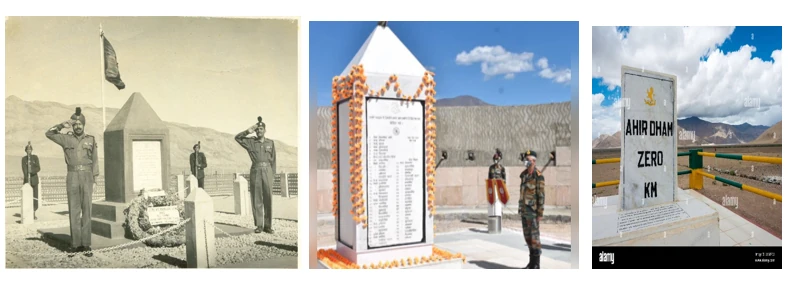
The Rezang La Memorial was constructed at High Ground by the Battalion, where mass cremation of 96 martyrs’ bodies recovered from Rezang La was done by the Paltan and Brigadier (later General) TN Raina, MVC with full military honours. Mortal remains of the late Major Shaitan Singh, PVC were flown to Jodhpur, where he was cremated with full military and state honour. The Memorial was inaugurated by Maj. Gen. Budh Singh, MC GOC of the newly raised 3 Infantry Division based in Leh, in the presence of Brig. Raina, Commander of the 114 Infantry Brigade and the CO and all ranks of 13 Kumaon. I attended the solemn function of the first Rezang La Day celebrations at the Rezang La Memorial at High Grounds in Chushul on November 18, 1963. According to Brig Jatar, who visited Rezang La Memorial in 2012, he noticed Ahir Dham signage built by Col (later Brig) VP Singh. Brig Jatar conveyed his disapproval to VP Singh, who promptly replied, ‘nikal dete hain,’ but Brig Jatar said it would hurt JCOs/ ORs so it was not removed. The memorial was renovated in 2021 to commemorate the 59th anniversary of the Rezang La Battle and inaugurated by Defense Minister Raj Nath Singh. The renovated memorial includes a double-storied museum, a mini-theater, and a large helipad without compromising the original structure and sentiments attached to it, making it a big future tourist attraction.
Family Pension Late Major Shaitan Singh, PVC
The late Major Shaitan Singh, PVC’s son Narpat Singh, filed a case in 2013 regarding non-payment of the special family pension to his mother in the Armed Forces Tribunal (AFT), whose after-retirement member was Lt. Gen. Bobby Mathews, the former COR. Because no LR was filed, the General requested the Applicant’s lawyer to file one so the case could progress. Most officers and veterans are unaware that Special Family Pension was inapplicable until 1972. Narpat Singh rang me too. He has apparently hired a lawyer, who has started to nitpick and advised him to approach AFT. The AFT’s well-reasoned judgment rejected the case, stating that it was aspirational and that all dues had been paid. Due to his old age, Narpat Singh is utterly confused, and his greedy lawyer, motivated by financial interests, is misguiding him. Such half-truths and outright lies tarnish the image of our Regiment and reflect poorly on military management. Many veterans from 13 Kumaon, who know me, inundate me with one-sided messages, especially because I have been involved in writing about Rezang La and other battles. It is confirmed that all entitled dues were paid and nothing was pending or outstanding; however, greed knows no bounds.
Ahirs’ Misgivings on 120 Bahadur
For the last decade or so, many Bollywood personalities, including Palash Singh, who worked as an assistant director under Prakash Jha, have contacted me about making a film on the Rezang La Battle or a biopic on the late Major Shaitan Singh, PVC, but none of these projects materialized. About two years ago, Razy Ghai and a couple of Bollywood luminaries visited me and expressed great enthusiasm for making a film about the Rezang La Battle. We interacted, and in his two more visits, he shared all my writings, photographs, and books on Rezang La. I shared details of Brig Jatar, Jai Samota, the author of the biography of Maj Shaitan Singh, and Honorary Capt Ram Chander, who was one of the six jawans who returned alive from the Rezang La Battle and was the radio operator cautioning them that he projects himself larger than life for self-glorification.
As the name of the film 120 Bahadur appeared in the initial teaser for the film some months back, some local politicians and Ahir veterans in Rewari/Gurgaon protested that the film glorifies the late Major Shaitan Singh vis-à-vis Ahir soldiers and started voicing their old demand for raising the Ahir Regiment, which 120 Bahadur and Razy Ghai have nothing to do with. Then they raised the issue of renaming the film as 120 Veer Ahir, which Razy Ghai declined, upsetting the local agitating Ahir leaders, who prevailed upon the Ahir community to boycott the film. Though I have no objection to the film’s title, 120 Bahadur, it would have been more appropriate to call it ‘REZANG LA,’ similar to ‘SARAGARHI,’ as it commemorates the bravery of 21 Sikh soldiers who stood their ground against an estimated 10,000 Afghan tribesmen in the Northwest Frontier Area on 12 Sept 1897, which would have helped keep the Ahir agitators at bay. The publicity write-ups, teasers, and trailers effectively promoted 120 Bahadur, featuring Farhan Akhtar in the lead role of Maj Shaitan Singh. It was screened prior to its release on 21 November 2025 in Mumbai and at a large number of military stations for viewing by serving soldiers, veterans, and their families. 120 Bahadur got wide publicity before its release and we who had served in 13 Kumaon just after the war enthusiastically waited for its release.
Razy Ghai: Neither Saint nor a Sinner
Much has been written about ‘The Battle of Rezang La,’ although the 1962 War and the HBR remain classified, with the report collecting dust in sealed government cupboards. Therefore, I do not plan to write any more about ‘The Battle of Rezang La.’ The factual story is covered extensively in our Regimental history book, ‘Valour Triumphs,’ written by Major KC Praval. I have also written extensively about the Battle, including the Coffee Table Book ‘Reminiscing Battle of Rezang La’ and others, such as Jai Samota, who covers it in his biographical book on Major Shaitan Singh.
Despite his self-glorifying contribution in the film, Sepoy Ram Chander, who carried the radio set of his Company Commander Shaitan Singh, was influenced by the retired Honorary Captain Ram Chander. He is seen in numerous videos and interviews with journalists and had tremendous influence on Razy Ghai in making the film, glorifying his role and overshadowing even his company commander and the rest of the other Ahir comrades in the actual battle. This avoidable hype is jarring, and many military veterans, like Lt. Colonel Chandu Lal, have conveyed it to Ram Chander Sahib. Razy Ghai had two meetings with me prior to the movie’s production, during which we discussed the terrain, the culture and social values of the Ahir troops, the personality of their dynamic yet modest Rajput Company Commander, the late Major Shaitan Singh, the conduct of the battle and its aftermath, the importance of adhering to a historically accurate chronology, and the importance of avoiding exaggeration in both the battle and the movie.
Nothing like Sepoy Ram Chander biking from Rewari to Rezang La to reach his unit happened in actuality, heightening his role frivolously. The time and resources spent glorifying him could have been better used to showcase the culture of Haryana and Rajasthan, as well as to accurately depict the historical events that were overlooked in the movie, as discussed in the following paragraphs. The vested coterie’s influence caused the movie makers to ignore, not consult, or not listen to the historians who have written about the Rezang La Battle and Brigadier (then Major) RV Jatar, living in Pune, who was deployed with B and D Companies at Mugger Hill across the Spanggur Gap during the battle; these experts knew the terrain, appreciated both broader strategic and ground-level tactical implications, and understood the troops under stress, operational tasks, and unwinding of the uncertainties during the battle. We must understand that radio set No. 62, which was used at that time for communication with Battalion Headquarters, was inoperable due to a frozen battery that was lying in Maj. Shaitan Singh’s bunker, and the telephone lines had been severed by heavy Chinese artillery bombardment. The only other sets operating were smaller short-range sets, No. 88 for communication with three platoons (7, 8 & 9) with Company Headquarters spread over 2-3 km distances. However, radio set operator Ram Chander emerges as a hero, sometimes overshadowing both the Company Commander and the entire Charlie Company, because Honorary Capt. Ram Chander was able to influence Razy Ghai more than his actual contributions warranted.
Just before the release of 120 Bahadur, there were protests in Haryana over the film by some local Ahir political leaders and military veterans. These protests were based on flimsy grounds, claiming that the Bhati Rajput Company Commander Major Shaitan Singh overshadowed the role of the Ahir troops, despite the fact that they had not seen the film. The film depicts that the Ahir troops shared a profound sense of camaraderie and bonhomie, knowing that their military commander always prioritized their well-being and fostered a united front against adversity that actually heightened the combat effectiveness in the Charlie Company during the fierce battle fought against heavy odds. Furthermore, the film is totally apolitical and has nothing to do with the raising of the Ahir Regiment.
I got views of two regimental three-star generals who saw it as an excellent movie, while the third said, ‘Personally, he was not impressed, either historically and commercially and the rest he could discuss post my watching the film.’ On Saturday, just a day after its release, my wife, daughter, and I watched the film, and I was saddened to see only 10 people in a large hall that could seat 500 viewers. I saw the film, which is very well cinematographically made, but it inaccurately depicts both the Ahir-Rajput culture and the battle’s tactical and historical accuracy.
Deployment of the Battalion on the ground was not depicted. While C Company was deployed at Rezang La with a section of 3” Mortar, under Major Shaitan Singh, 30 km south of Chushul, B & D Companies with Section 3” Mortar and Section MMG were deployed in Mugger Hill covering the Spanggur gap approach under Major RV Jatar, who was the overall post commander. A company plus four recoilless (RCL) guns was in brigade reserve under Major GN Sinha, poised for a counterattack with Battalion Headquarters at High Ground under CO Lt. Col. HS Dhingra.
The Chinese did not attack Mugger Hill on 18 November as expected but shelled it heavily. B Company had excellent observation of the Spanggur Gap and directed artillery fire on the enemy gun positions. The terrain and climatic conditions favored the Chinese, and they made most of them in the 1962 operations. D Company had sent a patrol to Rezang La under Naik Roop Ram and was engaged by the enemy MMG that killed two and wounded another two soldiers. Despite the enemy firing over 600 shells on Battalion Headquarters, thankfully, no casualties occurred. The film failed to capture these events.
On the night of November 18, 1962, after the snowstorm, visibility improved, and around 0200 hrs., the Listening Post (LP) ahead of 8 Platoon observed a large body of Chinese soldiers swarming through the gullies at a distance of about 700–800 meters from the pass. L/Nk Brij Lal, the LP commander, ran back to Platoon Headquarters and informed his Section Commander, Nk Hukam Chand, that one LMG was being rushed as reinforcement. With the enemy in range, the LP fired the predetermined red Verey Light signal along with long bursts of LMG fire, warning the C Company to ‘stand to’ in their dugout positions. Similarly, the 7 Platoon’s LP on the forward slopes observed enemy buildup and alerted the entire C Company. Major Shaitan Singh immediately contacted three platoon commanders on the radio set and ordered 9 Platoon to send a patrol to cover the wide gap between 7 and 9 Platoons.
Our troops on the ground were deployed tactically in trenches, but in the film, they were shown collecting, like a police force firing on the assaulting Chinese. Furthermore, the heroics of wrestler-soldier Lance Naik Sing Ram, who killed 6-7 Chinese soldiers in a hand-to-hand fight with a bayonet charge, were not shown in the film. Martyred Lance Naik Sing Ram earned a well-deserved VrC for his heroics.
The saga of Sepoy (later Havaldar) Nihal Singh’s daring escape adds another unique layer to the heroic saga of Rezang La, escaped by Razy Ghai in the film. The Chinese captured him as a prisoner of war (POW), but he successfully escaped by deceiving the enemy. After wandering, he reached headquarters on the afternoon of 19 Nov 1962 wounded and bleeding and was admitted to MH Jammu. A dog, who was occasionally fed by the Charlie Company soldiers at the Rezang La post, became his saviour and guided him back to Battalion Headquarters. He followed the dog through the rugged terrain, and after several hours, highly hallucinated, he reached back safely. He was awarded the well-deserved Sena Medal for his bravery.
Since the 3” Mortar Section had exhausted all its ammunition, Naik Ram Kumar, the Section Commander, ordered that it be disabled and destroyed to prevent it from falling into enemy hands. He was hit by enemy fire 20 yards away and his nose was shattered. Though wounded, he took position in his command post and pumped bullets on the peeping Chinese soldiers with his bolt action. He used a .303 rifle to kill many of the enemy soldiers. After many hours of profuse bleeding, he regained consciousness and painfully trekked back to Battalion Headquarters. How could Razy ignore this heroic act of Naik Ram Kumar, who was awarded the VrC and is one of the six survivors of the battle? Only if the film curtailed Sepoy Ram Chander’s unwanted acts would this have been possible.
Haryana is characterised by its distinct topography, economy, dialect, and folk culture. Its topography has helped people over generations evolve and sustain themselves as a distinct community through uninterrupted interactions. The music and the Haryanvi dialects in the film were not catchy. Actors in the film spoke neither Hindi/Hindustani nor the Haryanvi dialect but a poor mixture of both. The film was a war movie, and incorporating background music based on the Ahir Ragini folk songs, which are especially popular in Haryana and Rajasthan, would have made a greater impact. I distinctly remember advising Razy Ghai to keep in the background the folk song ‘उड़ उड़ रे म्हारा काला रे कागला’ that would go well with the Rajasthani and the Haryanvi troops deployed in war-like conditions.
I belong to Gurgaon and studied in the local college. I fluently speak the Ahir dialect and enjoy their Ragnis. I was commissioned in 13 Kumaon, the first pure Ahir Battalion. I served under Lt Col HS Dhingra, AVSM; Brig (later Gen) TN Raina, MVC; and Maj (later Brig) Jatar; commanded the Rezang La Company for many years; and served with the 6 survivors, understanding their characteristics and personalities well. The actors acting in the film did not resemble the personalities they acted for. For example, the actor acting for the Sikh CO Lt. Col. HS Dhingra, AVSM had a thick beard, while Col. Dhingra trimmed his mustache and beard regularly. Brig (later General/COAS) Raina was awarded the MVC in the Chushul theater in 1962. Many, including Razy Ghai, may not be aware that he was seriously wounded in a grenade-throwing accident in Kirkuk (Iraq), which left him with severe wounds in his thighs and resulted in the loss of an eye. He had a glass eye in place for the rest of his career in the army. The soldiers depicted in the film and those in real life were very different. I also do not recollect Chinese massacring any Indian border village as depicted in the movie.
Lastly, commenting on the film is much easier than making it. The suggestions I made earlier would not have turned 120 Bahadur into a box office hit, but they would have made the film more historically, culturally, and militarily accurate. The ‘Battle of Rezang La’ will be remembered for its bravery, sacrifice, and patriotism, which inspired young Razy Ghai to create the film 120 Bahadur; this film has ignited discussions about how Bollywood portrays historical events and highlights the role of every citizen in national security and the armed forces. It’s time the country ensures compulsory military training like Israel for the youth for 2-3 years, to appreciate and involve them in our armed forces and national security and appreciate that such ventures are not for the armed forces, their families or veterans but the whole nation to watch. With entertainment tax relief available in many areas, more and more people would be able to watch this military thriller.
My sincerest compliments to Razy Ghai for his motivation, missionary zeal, and dedication, as well as the entire 120 Bahadur team. I am sure he is motivated enough to make films like ‘The Battle of Badgam’ (first PVC, late Major Som Nath Sharma) and ‘The Battle of Walong’ in the near future.