


The domain of modern aerial combat has undergone a major shift from traditional dogfighting to one that is characterized by sensors, data, and situational awareness. At the heart of this transformation is the Active Electronically Scanned Array (AESA) radar, a technology that determines the efficiency with which a fighter aircraft can detect, track, and engage threats. The development of AESA radar capability is not just about improving combat performance for India; it is also about attaining technological independence.
This transition is evident in the Tejas Mk1A program. Initially, India depended on foreign radar systems; however, it is currently making progress toward an indigenous solution. The transition from the Israeli EL/M-2052 radar to the Uttam AESA radar, which was developed domestically, signifies a strategic and technological transformation.
EL/M-2052: A Dependable Imported Backbone
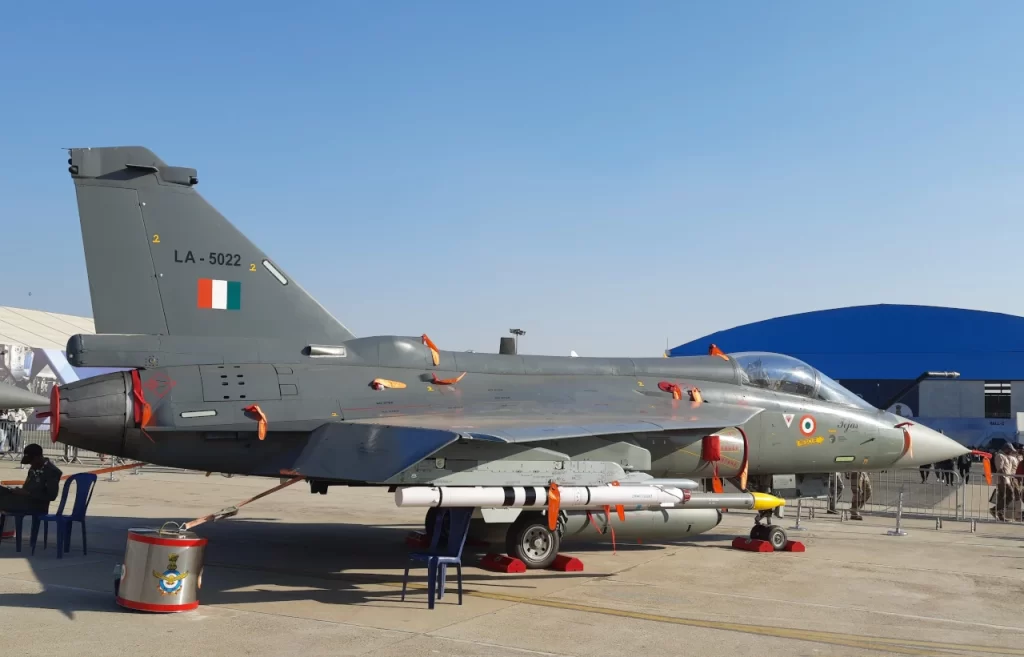
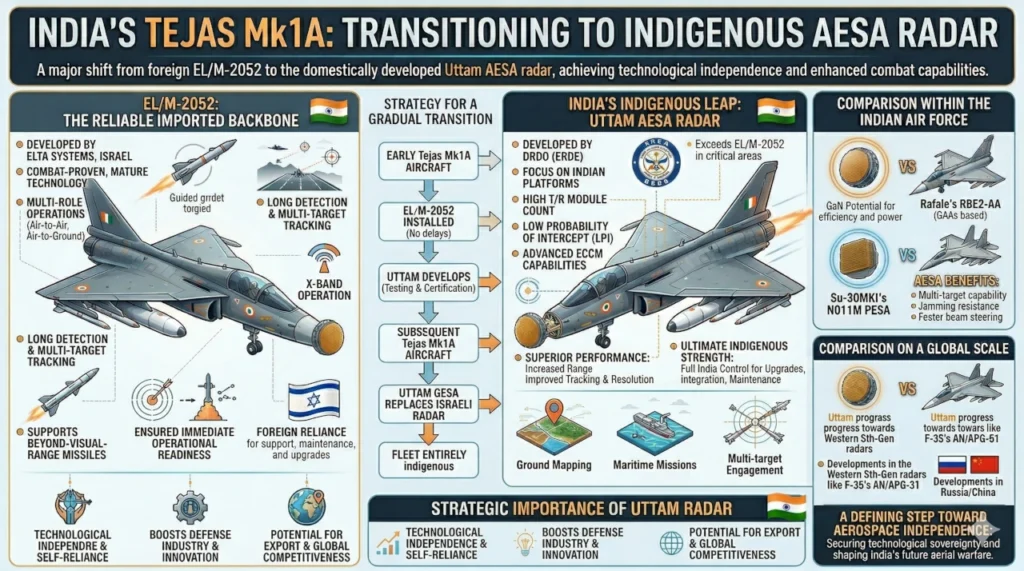
The initial radar for early quantities of Tejas Mk1A aircraft is the EL/M-2052 AESA radar, which was developed by Israel’s Elta Systems. It is a combat-proven, mature system that has been specifically designed for multi-role operations.
This radar is capable of detecting targets at long distances, monitoring multiple threats simultaneously, and supporting both air-to-air and air-to-ground missions. It operates in the X-band. It is a highly capable system due to its capacity to operate in complex electronic warfare environments, execute synthetic aperture radar mapping, and guide beyond-visual-range missiles.
The EL/M-2052 provided the Indian Air Force with an immediate solution during a period in which squadron strength required urgent reinforcement. It guaranteed that the Tejas Mk1A could be operational without any delays resulting from ongoing native development. On the other hand, its foreign origin necessitated reliance on external suppliers for long-term support, maintenance, and enhancements.
The Indigenous Leap Forward of India: Uttam AESA
The Uttam AESA radar, which was developed by the Electronics and Radar Development Establishment under the Defence Research and Development Organisation, is India’s response to this dependency.
Uttam is an important milestone in the aerospace endeavors of India. It is designed with a focus on Indian platforms and includes a high number of transmit/receive modules, electronic counter-countermeasures, and low probability of intercept capabilities.
From a performance standpoint, Uttam is engineered to exceed the EL/M-2052 across several critical areas. It provides increased target tracking capability, improved detection range, and improved resolution. The radar is capable of simultaneously tracking a considerably greater number of targets while maintaining the ability to engage them with precision.
Its multi-mode functionality enables it to seamlessly transition between maritime missions, ground mapping, and air-to-air combat. Its operational versatility is further enhanced by high-resolution imaging and ground moving target indication.
Uttam’s indigenous nature is its primary strength, in addition to its performance. India’s development, upgrades, and integration are entirely under its control, thereby eradicating the need for foreign vendors.
A Strategy for a Gradual Transition
India has implemented a pragmatic strategy for the integration of these radar systems into the Tejas Mk1A fleet. The EL/M-2052 radar is being installed on early aircraft, rather than waiting for Uttam to be fully operational. This guarantees that the Indian Air Force receives its deliveries without any delays.
Uttam will progressively replace the Israeli radar in subsequent production batches as it completes testing and certification. This phased transition enables India to maintain a balance between long-term strategic objectives and operational urgency.
The method also offers valuable real-world data, which allows engineers to improve Uttam’s performance ahead of large-scale deployment. It is expected that the Tejas Mk1A fleet will eventually transition entirely to the indigenous radar.
A Comparison Within the Indian Air Force
It is crucial to compare Uttam with other radar systems that are presently in service within the Indian Air Force in order to comprehend its significance.
Rafale’s RBE2-AA AESA Radar
Thales developed the RBE2-AA AESA radar, which is installed on the Dassault Rafale. This radar is presently one of the most advanced systems in the IAF’s service and has been demonstrated in many operational scenarios.
The RBE2-AA is characterized by exceptional multi-target tracking, high reliability, and robust resistance to electronic warfare. Nevertheless, it is predicated on an older technology known as Gallium Arsenide. In contrast, it is believed that future iterations of Uttam will incorporate Gallium Nitride technology, which will enhance efficiency and increase power output.
Although the Rafale’s radar has been refined and integrated over the years, Uttam’s growth potential may enable it to equal or exceed specific performance parameters in the future.
Legacy PESA Systems and the Su-30MKI
The Sukhoi Su-30MKI is dependent on the N011M Bars radar, which is a passive electronically scanned array system. Although it is quite formidable in its own right, it is devoid of numerous benefits associated with AESA technology.
Uttam and other AESA radars provide the capacity to monitor and engage multiple targets simultaneously with greater precision, as well as improved resistance to jamming and faster beam steering. Additionally, they necessitate less maintenance due to their modular structure.
It is being contemplated to upgrade platforms such as the Su-30MKI with AESA radars, and Uttam could be instrumental in these modernization efforts.
Jaguar DARIN III Enhancements
The DARIN III program has upgraded the SEPECAT Jaguar in Indian service, which incorporates the integration of the EL/M-2052 radar.
This results in an intriguing comparison, as the radar that serves as the baseline for Tejas Mk1A is already operational in another IAF platform. The eventual transition to Uttam would reduce reliance on imports and standardize radar technology across multiple aircraft.
Comparison of Uttam on a Global Scale
AESA radar technology is currently dominated by sophisticated systems that are deployed on Western and next-generation fighter aircraft on a global scale.
Western AESA Radars
The AN/APG-81 is a highly advanced radar that is seamlessly integrated with the sensor fusion architecture of aircraft such as the Lockheed Martin F-35 Lightning II.
In the same vein, the F/A-18 Super Hornet and Eurofighter Typhoon are equipped with state-of-the-art AESA radars that possess advanced electronic warfare capabilities.
Although Uttam may not yet achieve the same level of integration as fifth-generation platforms, it is rapidly approaching comparable levels in terms of basic radar performance. Its modular architecture enables future upgrades that could further reduce the disparity.
Developments in Russia and China
Russia is developing systems such as the N036 radar on the Su-57, while China has installed AESA radars on aircraft such as the J-10C and J-20.
India’s competitive position in this landscape is bolstered by the Uttam radar. Its indigenous development guarantees adaptability in enhancements and integration, which is a substantial advantage over imported systems.
The Transition to GaN Technology
The transition from Gallium Arsenide to Gallium Nitride technology is one of the most critical components of Uttam’s future development.
GaN-based radars provide enhanced thermal management, increased detection ranges, and a higher power output. Additionally, they are more resistant to electronic warfare and interference.
The incorporation of GaN modules is anticipated in future versions of Uttam, particularly those that are designed for next-generation aircraft such as the Tejas Mk2 and AMCA. As a result of this change, India may become a leader in radar technology.
India’s Strategic Importance
The transition from EL/M-2052 to Uttam is indicative of a more profound change in India’s defense strategy.
Initially, it improves self-reliance by decreasing reliance on foreign suppliers. This is essential for maintaining operational capability during conflicts, as external support may not be guaranteed.
Secondly, it boosts India’s defense industry by promoting domestic innovation and manufacturing capabilities. The development of technology in related sectors is also facilitated by the development of sophisticated radar systems.
Third, it enhances the potential for export. The Tejas aircraft is more appealing to international purchasers due to the absence of restrictions associated with foreign components, which is facilitated by the use of an indigenous radar system.
Challenges and the Future
Uttam is faced with many challenges, despite its potential. Extensive testing and validation are necessary for integration into operational aircraft. It is imperative to guarantee dependability in combat situations.
Another critical variable is production scaling. It will be vital to maintain consistent quality and performance as demand increases.
Furthermore, in order to remain competitive in the face of swiftly evolving global technologies, Uttam will require ongoing upgrades.
Conclusion: A Defining Step Toward Aerospace Independence
India’s radar strategy for the Tejas Mk1A is a cautious equilibrium between its immediate operational requirements and its long-term strategic objectives. The aircraft could enter service without delay as a result of the EL/M-2052’s dependable starting point.
Nevertheless, the development and integration of Uttam represent an important turning point. India’s transition from a technology importer to a developer of sophisticated defense systems is signified by this.
Uttam is a system that is capable and evolving, with significant growth potential, when contrasted with its global counterparts and extant IAF radars. It has the potential to become one of the most prominent AESA radars in the world as future variants integrate sophisticated materials and technologies.
Uttam is not just a radar; it is a representation of India’s aspiration to establish technological sovereignty and influence the future of aerial warfare in a broader context.