


Modern warfare has entered a phase in which visibility is constant, and survival depends on adaptation. The battlefield is no longer defined only by tanks, artillery, and infantry formations. It is now shaped by persistent surveillance, unmanned aerial systems, and rapid-response strike capabilities that can locate and destroy targets within minutes.
Today’s war zones operate under continuous Intelligence, Surveillance, and Reconnaissance (ISR). Movement is watched from above. Tanks that once dominated open terrain now face threats from machines that cost less than a soldier’s rifle. Videos circulating across the internet show tanks being struck from above, often through vulnerable points such as open cupolas. In many cases, these attacks result in catastrophic destruction, known as a “K-Kill,” where the vehicle is destroyed and rendered unusable.
This shift has forced militaries worldwide to rethink armour protection. Traditional frontal armour, once the focus of tank survivability, is no longer enough. The danger now comes from above, from small drones carrying explosive payloads with surprising precision.
The Rise of Low-Cost Drone Warfare
One of the most striking developments in modern conflict is the role of low-cost drones. These systems are inexpensive, widely available, and easy to modify for military use. In contrast to expensive anti-tank missiles, small drones can deliver destructive force at a fraction of the cost.
The threat is simple but devastating. A drone equipped with an explosive warhead can hover above a vehicle and release its payload directly onto vulnerable areas such as turret roofs, engine compartments, or hatches. Even heavily armoured vehicles can be destroyed if struck at the right point.
Conflicts in recent years have demonstrated how rapidly drone technology evolves. New tactics emerge within weeks. Countermeasures are developed just as quickly. Armies have introduced electronic warfare systems to jam drone signals and kinetic weapons to destroy incoming drones. Yet these solutions are expensive and require continuous upgrades.
In many situations, commanders have turned to simpler solutions that can be deployed quickly and affordably.
The Emergence of Cope Cage Armour
One such solution is the “cope cage,” a structure mounted above the turret of armoured vehicles. It resembles a metal pergola or lattice placed over the top of a tank. While it may appear improvised at first glance, its function is carefully considered.
The primary role of a cope cage is to create distance between the explosive payload and the vehicle’s main armour. By detonating the explosive before it contacts the surface, the cage reduces the blast’s effectiveness. This concept is not entirely new. Spaced armour has been used for decades. What makes cope cages different is their adaptation to counter aerial threats.

These structures were first widely observed on tanks during the early phase of conflicts in Eastern Europe around 2022. Soon after, similar designs appeared in other regions. Tanks massing near high-risk zones were photographed with cope cages installed, signalling that militaries recognised the urgent need for protection against drone-delivered explosives.
The logic behind cope cages is practical. They are relatively inexpensive to fabricate. They can be installed without major changes to vehicle design. Most importantly, they do not significantly restrict the combat capabilities of tanks, infantry combat vehicles, air defence platforms, or self-propelled artillery.
In a world where threats evolve rapidly, simple, scalable solutions become highly valuable.
India’s early recognition of drone threats prompted a shift from mere adaptation to the development of pioneering indigenous composite armour solutions, bolstering strategic confidence and showcasing national innovation.
India, with its long-standing emphasis on armoured warfare and mechanised formations, recognised the changing threat landscape early. The increasing use of drones in global conflicts highlighted vulnerabilities that could not be ignored.
Rather than relying entirely on imported technologies, India moved toward indigenous solutions. This approach aligns closely with the national vision of “Make in India” and “Stand-up India,” encouraging domestic innovation and self-reliance in critical sectors.

Prof. Dr Shantanu Bhowmik’s decade-long research at Amrita Vishwa Vidyapeetham exemplifies India’s commitment to innovation, culminating in advanced hybrid composite materials capable of resisting high-impact forces.
This long-term effort was not driven solely by short-term urgency. It reflected perseverance, technical skill, and the willingness to push the limits of materials science. The result was the development of a high-impact, high-resistance hybrid composite designed specifically for defence applications.
The Maharana Pratap Singh Composite Armour Plate
The collaboration between Amrita Vishwa Vidyapeetham and ACE Gas Conversions Pvt. Ltd., Mumbai, led to the creation of what is now known as the “Maharana Pratap Singh Composite” Armour Plate.
This innovation represents a major milestone in India’s journey toward indigenous defence technologies. Unlike conventional metal armour plates, the hybrid composite integrates multiple materials engineered to absorb shock, disperse energy, and maintain structural integrity under explosive stress.
The successful field test at Babina Range demonstrates the armour’s real-world effectiveness, fostering trust and confidence among defence professionals and policymakers.
The test parameters were demanding. An improvised explosive charge was used, consisting of:
- 500 grams of explosive material
- 800 grams of splinter material
- Total charge weight of 1.3 kilograms
The composite armour plate, measuring 1 meter by 1 meter and weighing approximately 110 kilograms, was subjected to the explosive impact.
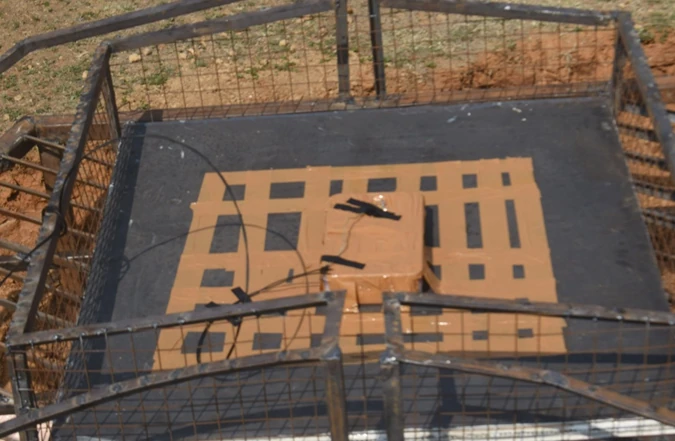
The outcome was highly encouraging.
The plate successfully sustained the blast, maintaining its structural integrity and demonstrating strong protective performance. This result confirmed that the hybrid composite has significant potential to protect military vehicles and installations against explosive threats.
Why Hybrid Composites Matter
Traditional steel armour provides strength but comes with weight penalties. Heavier vehicles consume more fuel, move more slowly, and place greater stress on mechanical systems. In contrast, hybrid composites offer several advantages.
First, they are designed to distribute energy across multiple layers. Instead of allowing a concentrated impact to penetrate, the material absorbs and disperses force across a wider area.
Second, composites can be engineered to address specific threats. By adjusting fibre types, matrix materials, and layering patterns, scientists can tailor the material to resist blast pressure, fragmentation, or penetration.
Third, lighter armour improves mobility. In modern warfare, mobility often determines survival. Vehicles that move faster and manoeuvre effectively are harder targets.
Developing hybrid composites offers a strategic advantage, reinforcing India’s position as a leader in defence innovation and ensuring future battlefield resilience.
Application as Cope Cage Armour
The hybrid composite developed through this research has shown strong potential for use as a cope cage armour. Instead of relying solely on metal frameworks, integrating composite panels into cage structures could significantly improve survivability.
A composite-based cope cage offers multiple benefits:
- Improved blast resistance
- Reduced overall weight
- Enhanced durability
- Greater protection against fragmentation
Such systems can be mounted on tanks, infantry combat vehicles, air defence platforms, and self-propelled artillery units. The modular nature of composite plates allows them to be installed or replaced quickly, making them suitable for field-level deployment.
In practical terms, this means that Indian armoured units could adopt protective systems tailored specifically to emerging threats from drone warfare.
Indigenous Innovation and Strategic Independence
One of the most significant aspects of this development is its indigenous nature. The composite armour technology is entirely developed within India, making it a first-of-its-kind achievement in the country.
Indigenous production reduces reliance on foreign suppliers. In times of conflict or geopolitical tension, access to imported defence materials can become uncertain. Domestic capabilities ensure continuity and flexibility.
This development also strengthens India’s defence manufacturing ecosystem. Universities, private companies, and military units working together create a model for future innovation. Such partnerships encourage knowledge transfer and accelerate development timelines.
The success of this project demonstrates how academic research can translate into real-world defence solutions.
Implications for the Future Battlefield
The battlefield of the future will likely see even greater reliance on unmanned systems. Drone swarms, autonomous surveillance platforms, and precision-guided munitions will continue to shape combat strategies.
In such an environment, survivability depends on layered protection. No single solution is enough. Instead, armies must combine:
- Electronic countermeasures
- Active protection systems
- Passive armour technologies
- Tactical mobility
Cope cage armour, especially when enhanced with hybrid composites, represents a practical layer within this larger defensive network.
The ability to quickly upgrade existing vehicles without a complete redesign is particularly valuable. Modernising an entire fleet of armoured vehicles is expensive and time-consuming. Installing protective structures, on the other hand, provides immediate benefits.
A Model for “Make in India” in Defence
The development of the Maharana Pratap Singh Composite Armour Plate aligns closely with national initiatives to boost domestic manufacturing.
“Make in India” is not just about producing goods within the country. It is about creating value through innovation, research, and technological leadership.
This project embodies that philosophy. It shows that Indian scientists and engineers can develop world-class materials capable of addressing modern military challenges.
“Stand-up India,” which encourages entrepreneurship and innovation, is also reflected in this collaboration between academia and industry. Private companies working alongside research institutions create pathways for commercialisation and large-scale production.
Such models can be replicated across other sectors, from aerospace to cybersecurity.
Beyond Military Use: Potential Civil Applications
While the immediate focus is on military protection, hybrid composite technologies have broader applications. Materials designed to withstand explosive forces can be adapted for civilian safety.
Possible uses include:
- Protective barriers for high-risk installations
- Blast-resistant structures in industrial zones
- Safety infrastructure in transportation hubs
- Reinforced shelters in disaster-prone areas
By extending these technologies into civilian sectors, the benefits of defence research can reach a wider society.
The Human Element Behind Technological Breakthroughs
Every technological achievement carries a human story behind it. In this case, Prof. Dr Shantanu Bhowmik’s journey stands as an example of persistence and long-term vision.
Ten years of focused research is not a short commitment. It involves repeated experiments, failures, refinements, and validation cycles. Achieving measurable success in materials science requires patience and collaboration across disciplines.
Recognition of such efforts encourages younger researchers to pursue ambitious projects. It
also reinforces the importance of sustained investment in research institutions.
Looking Ahead: From Prototype to Deployment
The successful field test marks an important milestone, but it is only the beginning. The next phase involves scaling production, conducting additional trials, and integrating the technology into operational systems.
Future tests may include:
- Multiple explosive scenarios
- Fragmentation impact studies
- Long-term durability testing
- Environmental stress evaluation
These steps ensure that the material performs reliably under diverse battlefield conditions.
If production scales effectively, India could deploy indigenous composite-based cope cage systems across various armoured platforms. This would represent a major step toward enhancing force protection and reducing casualties.
Conclusion: Protecting Steel, Preserving Lives
The evolution of warfare has made survival more complex than ever. Tanks that once dominated battlefields now face threats from machines smaller than birds. Adaptation is no longer optional. It is essential.
The development of high-impact-resistant hybrid composite armour marks a turning point in India’s defence capabilities. It reflects the power of indigenous innovation, collaborative research, and strategic foresight.
More importantly, it represents a commitment to protecting soldiers. Every improvement in armour technology increases the chance that crews survive attacks and return home safely.
In the larger picture, this innovation signals confidence. It shows that India is not merely reacting to global changes but actively shaping its own technological future.
From drone-threat countermeasures to advanced composite armour, the message is clear: the next generation of battlefield protection will be built not just with steel, but with science, resilience, and national determination.
Manoj, read it through. Happy to see that action sare in place. Surely, more such ideas, using more suitable material will come to the fire. Thanks.