

It was 11th June 2011, around 9 AM, when Fida, Husain’s nephew, called from Dubai to inquire whether the news he had heard about Husain Sb was true. I told him that I would check with my wife, Rashda, who was in London with Husain, and get back to him. I then called Rashda on her mobile. She had already been at the hospital since early morning. Before I could say anything, she said, “Yes, Ahsan, we have lost Husain Sb. He passed away around 2:00 AM last night.”
Just as I put the phone down, the doorbell rang. It was Prakash Pandey from Star TV who had arrived with his team. He knew us well and wanted to interview me for a story on Husain Sb, being the first in the media to break the news of his passing. I told him that I will first check with Rashda on the matter and then decide. I again called Rashda and asked her whether it was proper for me to do so. She said the family has still not announced his passing away. Hence, I better stay away from the matter and not get involved unnecessarily in any kind of controversy. I told Prakash accordingly. He then asked if he could take some pictures of Husain’s paintings that were hung on the walls of our house, to which I agreed. After a while he came into the room saying that his producer was on the line and wanted to have a chat with me. All along, I had no idea that it was all being recorded at the other end. After some time, I started getting calls from people who heard my voice on the news broadcast about Husain’s passing away.
Next morning in newspapers, the story was screaming headline news. One said, “India’s Picasso,” dies in exile.
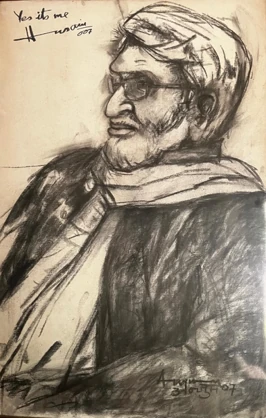
Just before going to the hospital, he was quite cheerful, as always. Even en route to the hospital, he was making plans for the evening. He had a restaurant in mind that made a particular French dish very well, and he wanted to go there in the evening. At the hospital, when the doctors examined him, they realized how serious he was. His heart was not functioning well, so his vital organs were receiving insufficient blood supply. He was still quite optimistic about himself and also expressed a desire to eat ‘sewaien,’ a sweet preparation made with vermicelli. It would have been there on his table the next day, but he passed away before that could happen. The doctors had already advised him not to paint to avoid exertion, so he would take a pencil and paper and sketch, continuing to churn out masterpieces until his last breath.
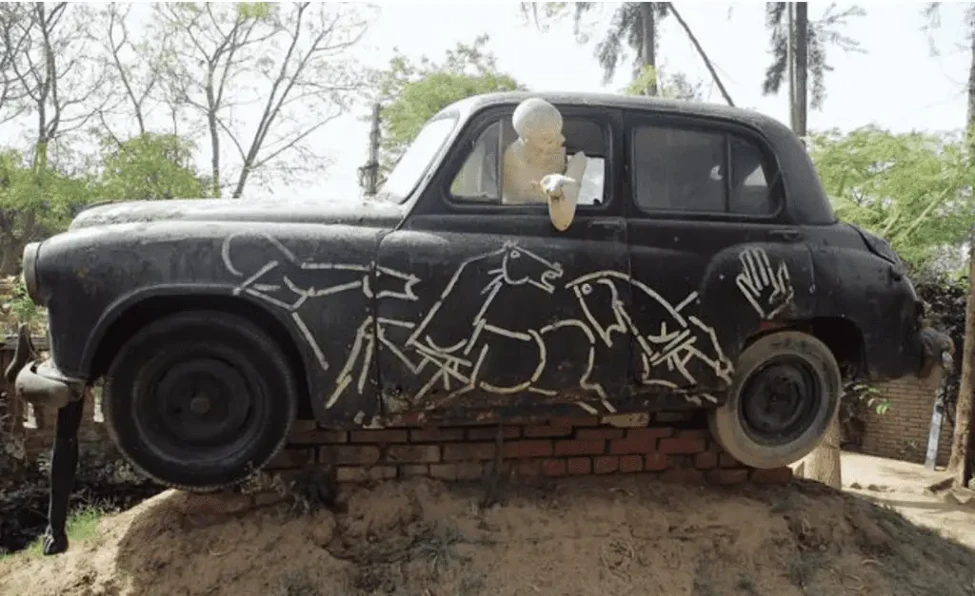
Husain Sb first set his sacred footsteps in our house on 27th Jan 1977. That was the birthday of our elder daughter, Shireen. His habit of walking barefoot left an indelible impression on everyone in our house. His black Hillman car, with his trademark painted horses all over, had found a permanent parking place outside.
His self-confidence at his ability was also amazing and gave jitters to the organizers of his exhibitions. Once a major show was scheduled to be held in Cyprus. The show was organized by the Government of India. Husain Sb landed there a few days prior to the show. A senior Diplomat who went to receive him asked Husain Sb “Where are the paintings?” His answer was, “I still have to paint them.” They could barely believe their ears. Husain has come empty-handed without the paintings for the show!
They told him it would have been better if he had not come at all. They could at least say to people that he was unwell.
In the evening the diplomat came to Husain Sb to take him out for dinner out of shared courtesy. The next morning, when the diplomat did not come to accompany him for breakfast, Husain went to his room and asked, “Aren’t we going for breakfast?” Reluctantly he came along and Husain took him to his room, which was on the way. The diplomat was surprised to find the entire floor of the room lined up with freshly painted canvases. Quick-drying acrylic paint had not yet come on the market. Hence, the paintings had to be left in the open for some time to allow the wet paint to dry up. The canvases were already stretched, so the moment the painting was finished, it was ready to be hung.
Other embassy staff, unaware of Husain Sb’s rare marathon painting feat, were surprised to find the complete painted canvas ready to be hung for the show.
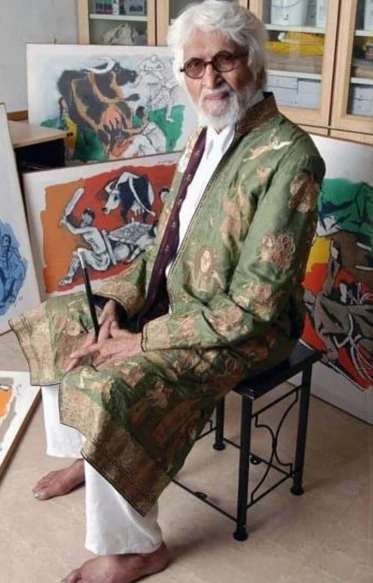
Husain never carried paintings for an exhibition, unlike other artists. The speed, at which he painted, was indeed amazing. It appeared as if the image of what he wanted to paint was already formed in his mind and he was merely acting as a printer, transferring that image onto the canvas or whatever medium he had chosen. Even when he exhibited his paintings in São Paulo, South America, along with Pablo Picasso, he never carried any paintings with him. He arrived at the venue a few days earlier and painted all his works.
Whenever in Delhi, Husain’s favourite tea joint was Nizami Hotel in the Nizamuddin area. He is always to be found in this hotel in the mornings sipping a cup of tea served in glass. Qamar, the waiter in the hotel, would yell at the cook the moment he saw Husain Sb alighting from his car, “Husain Sb ki chai aadha dhoodh, aadha pani, patti tej, chini kam.” This was the whole recipe for Husain’s favourite beverage. Nizami hotel is a dhaba frequented by most daily wages workers like mason, carpenter and others, who come there for early morning breakfast before they set off to their work site. Once a mason saw Husain Sb come out of the car barefoot and sit opposite him on the table. Assuming that he was a driver by profession, he remarked, “Aapki noukri bohut achi hai. Kam ka kam ghomna alag. Lagta hai ki aapka malek bohut meharbaan hai!’ Husain replied, ‘Yes, the malek indeed is very meherbaan.” (Here, the connotation of Malek is the god almighty.) Husain picked up a brush from the mason’s tools and made several imaginary strokes in the air, at which the mason remarked, “There is a lot of flexibility in your hand in the way you made these strokes in the air.” Maybe you can paint well.” At this Husain remarked, “Yes, I have used this extensively”.
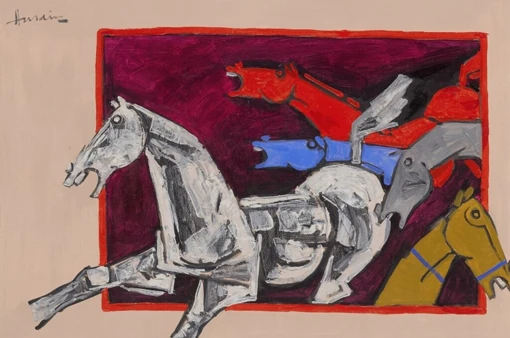
Husain is famous for his paintings of horses. He has been closely connected with horses since childhood. Horses are considered one of the most beautiful animals because of their physical power and elegance. Having lost his mother at the age of one, he grew up in the care of his grandfather Dada Abdul, who was his constant companion until he died when Husain was eleven years old.
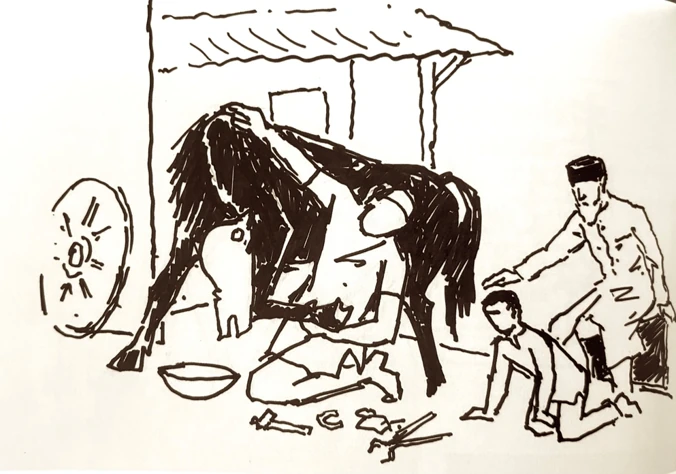
Every afternoon, Dada Abdul would visit the shop of his friend Achhan Mian, who was a ‘Nalband’ (one who fixed horseshoes on the hooves of horses) by profession. Husain used to watch different breeds and types of horses that came to Achhan Mian’s shop. They were from the Raja’s Palace, tall dark ones, the ones that drove tongas, and also from the English soldiers from the nearby cantonment. Husain would watch Achhan Mian pull out burning iron pieces from the fire with tongs and beat them to shape according to the shape and size of the horses’ hooves. Husain would draw the sketch of the horses he saw by using burnt charcoal on the ground or on the walls.
In 1952, Husain went to China in a cultural exchange programme. Chinese horses made with brush and ink were very famous at that time. Husain learned that Artist Chi Pa Hun was the most celebrated painter of horses in China. Husain went to meet him, who was 90 years old then. Chi Pa Hun made a sketch of his horse and gifted it to Husain. On returning from China, we find a new element added to the horses he painted. To the elegance and beauty of a woman’s body and the strength of a male, the ferocity of a charging dragon was now added. Husain has made paintings of many horses, who have become as famous as Husain. His horses made in different situations and different colors reflect a different emotion.
Several interesting incidents happened in Husain Sahab’s company. Once we had gone to pick him up from the airport in Delhi. At that time, the New Delhi Airport had only a single terminal from where all international and domestic flights operated. The parking was some distance away, across the road. When the flight arrival was announced, I left the car with my wife, Rashda, sitting inside. I told her that in case a traffic cop came, she should tell him that we had come to take a very elderly person who could not walk the long distance to the parking lot. When I came back, I found the car front-jacked up with her sitting coolly inside. I pleaded with the cop, who directed me to the traffic inspector coming in our direction. I repeated my plea to him. He looked inside and instantly recognized Husain Sahab. “Arre, yeh to apne Husain Sahab hain. Hatao bhai, hatao,” he said, pointing to the jack, which was promptly removed by the cops. He then inquired about Husain Sahab’s good health and waved us off. Such was his popularity that he was known to one and all, irrespective of their profession.
In another incident in Mumbai, when he had just become an MP (Rajya Sabha), he entered a lane and was stopped by the cop. He fumbled in his pocket to take out his ID thinking that the cop did not know him. Before he could do that, the cop leaned forward and said gently, “Husain Saab Aap ‘No entry’ lane mein aa gaye hain.” He then guided us out of the area. This shows the popularity and love of the people for the great man.
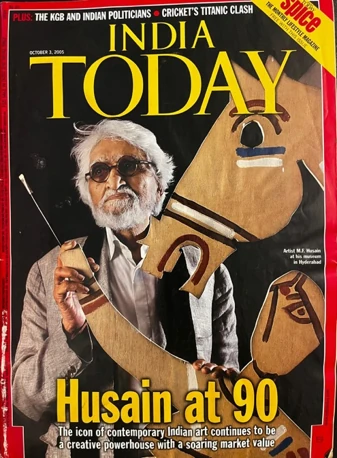
One day, Husain Sahab came to New Delhi from Mumbai and said he was going to Australia but had no visa. He did not know anyone in the Australian Embassy. I said to him, “Husain Sahab, you need not know them, but they would know you! “Let’s go to the Embassy.” And so, we landed at the Australian Embassy. At the entrance, a notice was put up saying that all visa applications were to be submitted at the designated VFS and that the embassy would not accept any visa applications. The magazine India Today had just published an article on Husain Sahab with his full picture on the front page. I gave the magazine to the security guard and told him to go inside and tell his superiors that the person in the picture had come to see them. He went inside, and promptly someone came out and escorted us in. They asked Husain Sahab how they could help him. When Husain expressed his desire to visit Australia, they took out a passport form, detached the medical inspection part, and gave it to Husain Sahab to get completed while they processed his visa application.
Dr. Khosla, a close friend of Husain Sahab, lived in Jor Bagh, which was within 30 minutes or so driving distance. We drove to meet him, and he filled out the necessary details on the form. Coming back to the embassy, we found that an impromptu tea party had been organized in his honour to enable the embassy staff to meet the great painter.
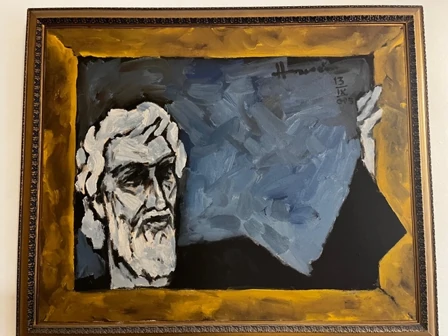
Husain Saab believed in re-birth; perhaps another legendary painter was born somewhere on this planet the day Husain Sb passed away. That person should be 13 years of age now. It will be an interesting subject for study by art scholars and historians if they can connect the two legends together. Only time will tell if that would happen.